Akira Ransomware Bypasses EDR by Rebooting into Safe Mode, Fails to Encrypt But Steals Data
A recent **Akira** ransomware affiliate incident highlights a concerning tactic: disabling endpoint detection and response (EDR) solutions by leveraging Windows Safe Mode. While the encryption payload ultimately failed, the attackers successfully exfiltrated sensitive data, underscoring persistent vulnerabilities in initial access and defense evasion.

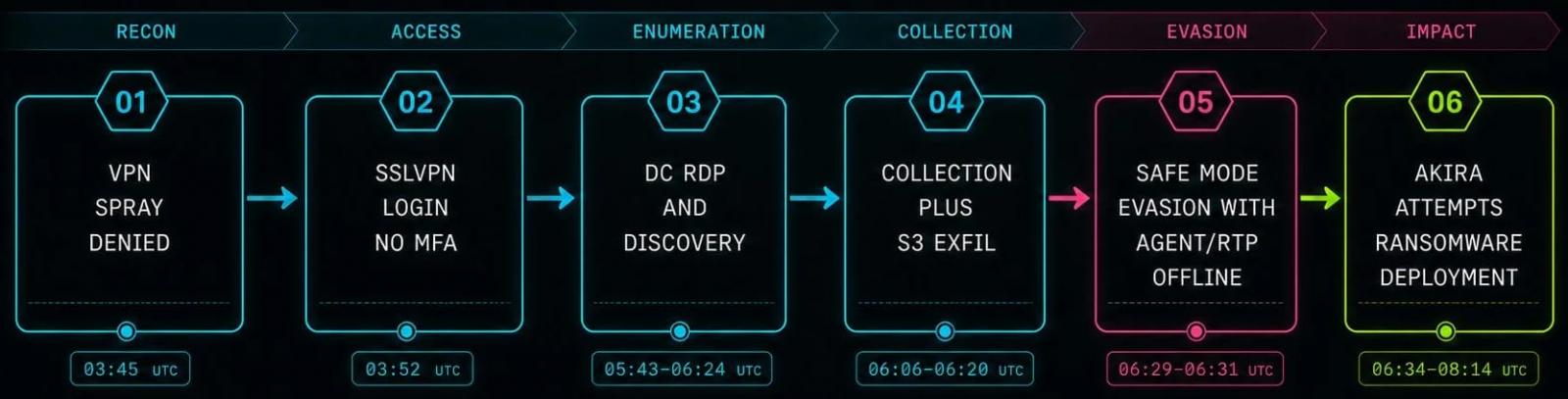
An **Akira** ransomware affiliate recently demonstrated a sophisticated evasion technique, disabling the endpoint detection and response (EDR) solution on a compromised system by forcing a reboot into Safe Mode with Networking.
The attack, which occurred on August 4, began with initial access gained through an exposed **SonicWall VPN** device lacking multi-factor authentication (MFA).

**Huntress**, a managed detection and response (MDR) services company, reported that approximately two hours after a successful VPN login, the attacker connected to the domain controller via RDP. They then enumerated **Active Directory** users and computers before moving to an application server.
The attackers utilized **WinRAR** to archive mapped file shares and the `s5cmd` command-line tool to upload the stolen data to an attacker-controlled S3 bucket. Following this, **AnyDesk** was installed for persistent remote access.
It was at this stage that the attacker used **AnyDesk** to force the compromised host to boot into Safe Mode with Networking, effectively disabling both the **Huntress** agent and **Microsoft Defender**’s real-time protection.
Safe Mode is a Windows startup state designed for troubleshooting, loading only a limited set of drivers and services. This typically prevents most third-party software and services from loading.
For a critical 10-minute window while in Safe Mode, "the host had no working EDR, and AV was blinded," **Huntress** stated in their analysis.
During this period, the attackers added **AnyDesk** to Windows’ Safe Mode registry, ensuring continued remote access after the reboot.
However, their attempt to launch the main ransomware payload (`akira.exe`) via **AnyDesk** in Safe Mode failed. The system reported low virtual memory and generated out-of-memory and **PowerShell** errors.
A scheduled **Defender** scan eventually detected the **Akira** executable, despite real-time protection being disabled in Safe Mode. However, the security tool could not remove it while the machine remained in that mode.
**Defender** only quarantined the file after the attacker rebooted the system into normal mode, which restored real-time protection.
Despite the failure to encrypt files, the **Akira** operator successfully exfiltrated credentials and files for data extortion, all within less than five hours from initial access.
**Huntress** noted that while other ransomware families like **Snatch** and **AvosLocker** have employed this tactic for years, this incident marks the first observed use by an **Akira** affiliate.
Researchers recommend implementing MFA for all VPN accounts, deploying credential-spraying detection measures, and continuously monitoring for Safe Mode boot configuration changes or remote-access tools being added to the Safe Mode service registry.