Android 17 Elevates Privacy with Platform-Wide ECH, Enhanced Network Protections
Google is rolling out significant network security enhancements in **Android 17**, introducing platform-level support for Encrypted Client Hello (ECH). These updates aim to bolster connection privacy, mitigate cellular vulnerabilities, and safeguard users' home networks against sophisticated tracking and interception methods.

Google is set to introduce a suite of new network security protections within **Android 17**, designed to fortify connection privacy, address cellular vulnerabilities, and protect the sanctity of users' home networks.
Central to these advancements is the integration of **Encrypted Client Hello (ECH)**, a cutting-edge privacy standard that works in concert with private DNS to obscure profiling metadata, including the domain names users visit.
**ECH** functions as a crucial privacy extension for **TLS**, the protocol underpinning secure HTTPS connections. It encrypts the initial phase of the **TLS** handshake, specifically concealing the Server Name Indication (SNI) which traditionally reveals the contacted hostname.

Even when a connection to a website or service is secure, Internet Service Providers (**ISPs**) and Wi-Fi operators can still discern the destination, data often collected for commercial profiling. By encrypting this crucial piece of information, **Android 17** aims to close this privacy gap.
While **Chrome 117** and later, and **Firefox 119** and later, already offer **ECH** support for browsing, **Android 17** integrates this protection at the platform level, making it a foundational element of the operating system.
Google's announcement clarifies, "This new privacy standard works in tandem with private DNS to obscure the domain names you visit, hiding metadata that can be used to profile you. By encrypting the destination website name from the very start, **ECH** helps ensure that, for supported websites and apps, network providers and network snoopers can no longer easily see which websites or apps you are accessing."
**ECH** will be enabled by default for applications targeting **Android 17**, provided they utilize a compatible networking library such as the latest versions of **OkHttp**, **WebView**, or **HttpEngine**.
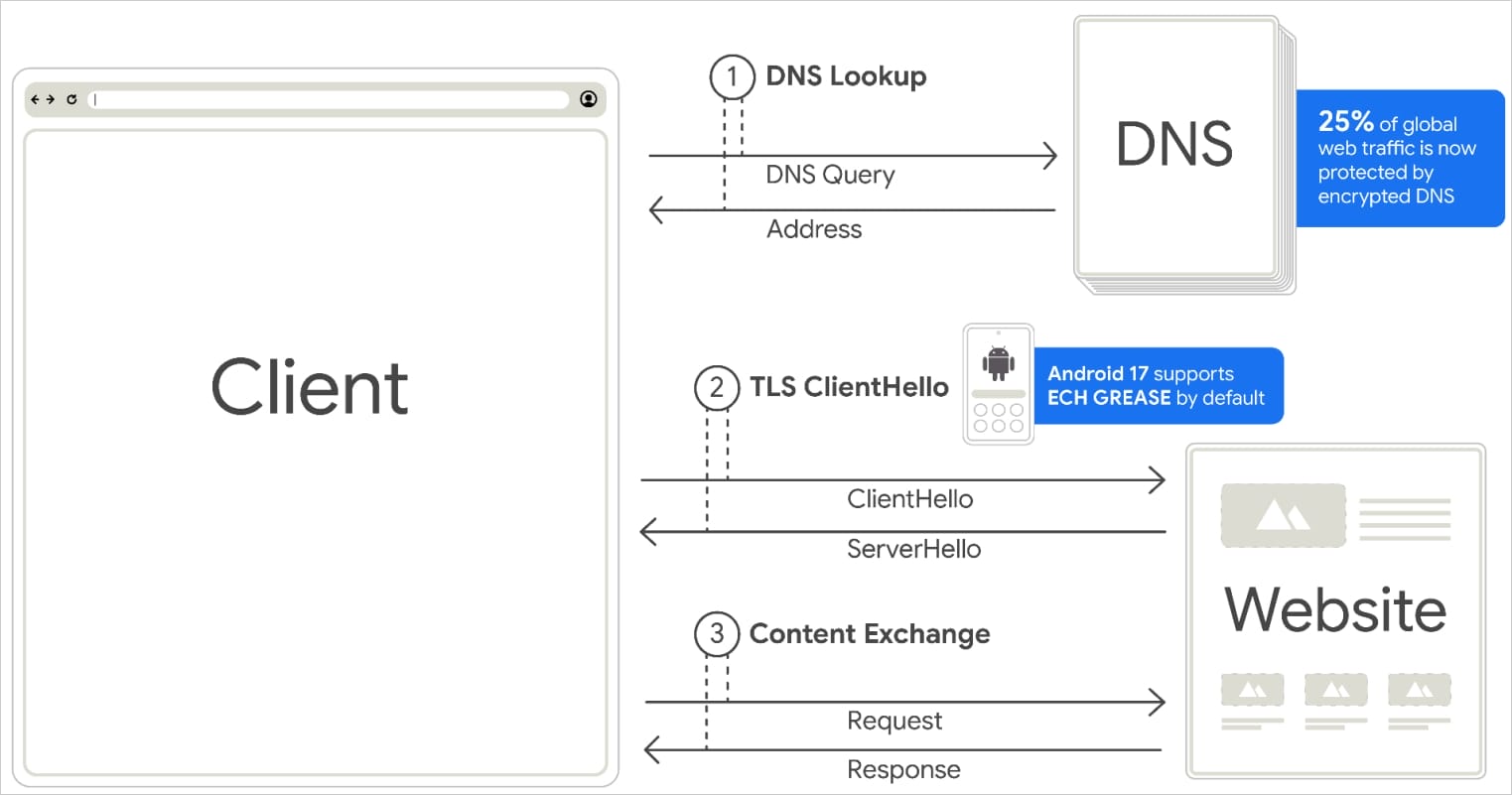
Google explains that on servers supporting **ECH**, **Android** will encrypt the hostname. For servers lacking **ECH** support, **Android** will transmit a dummy **ECH**-like field, known as **ECH GREASE**. This ensures that legitimate **ECH** connections do not stand out, although the hostname will still be visible in these cases.
**Jigsaw**, Google's unit focused on internet privacy and anti-censorship technologies, rigorously tested **ECH GREASE** across the top 10,000 domains and 740 internet providers in 202 countries. The tests revealed no site-loading issues or unexpected network blocks, affirming the robustness of this implementation.
### WiFi Protections and 2G Blocks
Beyond the extensive rollout of **ECH** on **Android**, Google also unveiled several other critical network protections designed to enhance user security and privacy:
* **Local Network Protection Adjustments**: Apps will now be required to obtain explicit permission before scanning for or connecting to devices on a user's local network, adding a layer of control and transparency.
* **Certificate Transparency by Default**: **Android 17** will enable **Certificate Transparency** by default. This mandates that website certificates appear in public logs, significantly increasing the difficulty of using forged certificates without detection.
* **Automatic 2G Disablement**: Participating mobile operators will gain the ability to automatically disable **2G** for their subscribers. This move aims to reduce user exposure to threats such as **SMS** blasters and rogue base stations capable of delivering malicious messages or intercepting sensitive traffic from nearby devices.
These combined network security enhancements in **Android 17** underscore Google's ongoing commitment to user privacy and security in an increasingly complex digital landscape.