Anthropic Rolls Out Invisible Watermarks for Claude-Generated Text Globally
In a move towards greater transparency and regulatory compliance, **Anthropic** is implementing invisible watermarks for text generated by its **Claude** AI models. This initiative, initially driven by the **EU AI Act**, will see watermarking applied globally to help identify AI-produced content without impacting quality or readability. The technology, inspired by **Google DeepMind's SynthID-Text**, subtly alters the randomness in token selection, creating a detectable statistical pattern.

The digital landscape is increasingly populated by AI-generated content, prompting a global push for better identification mechanisms. The **EU AI Act** mandates that AI companies serving its market clearly mark AI-generated content. In response, **Anthropic**, a leading AI provider, has become one of the first to detail its implementation of invisible watermarking across its **Claude** models.
While the primary driver is EU compliance, **Anthropic** confirmed that the watermark will initially be applied to **Claude**-generated text worldwide. "We’re applying watermarking globally at launch because we don't yet have a durable way to scope it by region," the company explained in a blog post. Future **Claude** models will incorporate this feature, with efforts underway to add it to models launched before August 2, 2026, which fall under the EU's transition period.
### How Claude's Watermark Works
Unlike traditional watermarking that might add hidden characters or visible markers, **Anthropic**'s approach is far more subtle. It's based on **Google DeepMind's SynthID-Text** methodology and operates during the text generation process itself.
AI models generate text by making a series of choices about which token (word or sub-word unit) comes next. **Claude**'s watermark subtly alters the source of randomness used in these choices, particularly in 'low-stakes' situations where multiple reasonable options exist. This creates a statistical pattern within the text that is imperceptible to the human reader but detectable with a specific key.
> Generative watermarking works by carefully modifying the next-token sampling procedure to inject subtle, context-specific modifications into the generated text distribution. Such modifications introduce a statistical signature into the generated text; during the watermark detection phase, the signature can be measured to determine whether the text was indeed generated by the watermarked LLM. A key benefit of the approach is that the detection process does not require performing computationally expensive operations or even access to the underlying LLM (which is often proprietary).
This means no extra tokens are added, and there are no hidden characters that could be accidentally revealed or interfere with the text. **Anthropic** reports that internal testing shows no discernible impact on the creativity, readability, or overall quality of **Claude**'s output, and a negligible effect on generation speed.
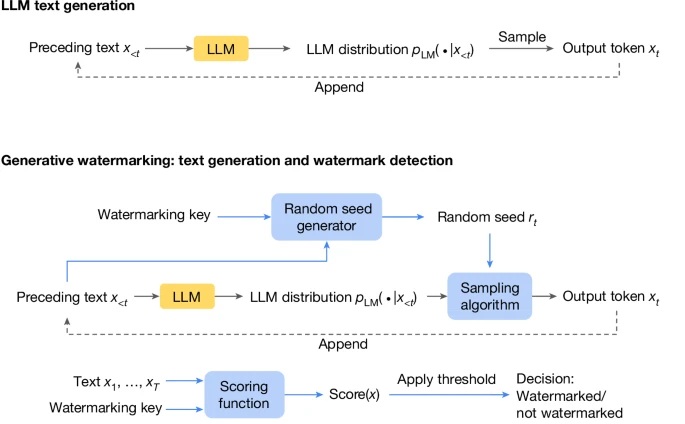
**Google's research paper explains how watermarking works**
Source: Google DeepMind
### Exceptions for Factual and Code Generation
**Anthropic** acknowledges scenarios where watermarking is not applied, primarily for factual statements and code. In cases where there is only one correct answer or where altering a term could break code, the watermark does not interfere.
"Where an *exact* output is required—where there isn’t a choice, and something would be factually wrong or a piece of code would break if a different term was chosen—the watermark isn’t applied," the company stated. While comments within code may still carry watermarks, the core functionality of the code remains uninfluenced.
This aligns with observations from the **SynthID-Text** paper, which notes that watermarking is less effective in low-entropy situations where the LLM distribution is highly predictable.
It's also important to note that light human proofreading may not provide enough **Claude**-generated material for reliable detection, as the watermark applies only to words chosen by **Claude**.
### Forthcoming Detection API
To facilitate the identification of **Claude**-generated content, **Anthropic** plans to offer a watermark detection API. This API will estimate the likelihood that **Claude** was involved in writing a piece of text. However, **Anthropic** clarifies that this is not a definitive proof of authorship, nor can it identify content from other AI models using different watermarking methods.
"A watermark can only determine that **Claude** was likely involved with the content at some point. It cannot distinguish 'Claude wrote this' from 'Claude heavily edited this.'" While light editing might not remove the watermark entirely, a complete rewrite would.
For AI-generated images (PNG, JPG, and SVG files), **Claude** will use a different approach, attaching cryptographically signed **C2PA** provenance metadata instead of embedding a watermark directly into the file.