Apple Blocks Over $2.2 Billion in Fraudulent App Store Transactions in 2025
**Apple** announced it prevented over $2.2 billion in fraudulent transactions on the **App Store** in 2025 alone, highlighting the increasing sophistication and scale of malicious activities targeting the platform. The tech giant continues to invest in advanced technologies and human review processes to combat fraud and protect users.


**Apple** has revealed its ongoing efforts to combat fraud within the **App Store**, reporting that it blocked over $11 billion in fraudulent transactions over the past six years. In 2025 alone, the company prevented more than $2.2 billion in potentially fraudulent transactions, demonstrating the persistent threat landscape.
### Proactive Measures and Account Terminations
In a press release, **Apple** detailed various measures taken to protect users and developers. These include:
* Rejecting over 2 million problematic app submissions in 2025.
* Blocking more than 1.1 billion fraudulent account creations.
* Terminating 193,000 developer accounts due to fraud concerns.
* Rejecting over 138,000 developer enrollments.
* Deactivating an additional 40.4 million customer accounts suspected of fraud and abuse.
### Financial Safeguards
**Apple** also reported significant successes in preventing financial fraud:
* Stopping more than 5.4 million stolen credit cards from being used in 2025.
* Banning nearly 2 million user accounts from making further transactions.
These figures represent a substantial increase compared to 2024, underscoring the evolving nature of fraud tactics. In 2024, **Apple** blocked over $2 billion in potentially fraudulent transactions, identified nearly 4.7 million stolen credit cards, and blocked over 1.6 million accounts.
"**Apple** utilizes both human review and advanced technology to identify and stop the use of stolen financial information," the company stated. "By leveraging machine learning, **Apple** teams build powerful models to accelerate fraud detection and quickly evaluate new deceptive tactics. These technologies also provide a comprehensive view of fraudulent activity across customer accounts, devices, and payment methods."
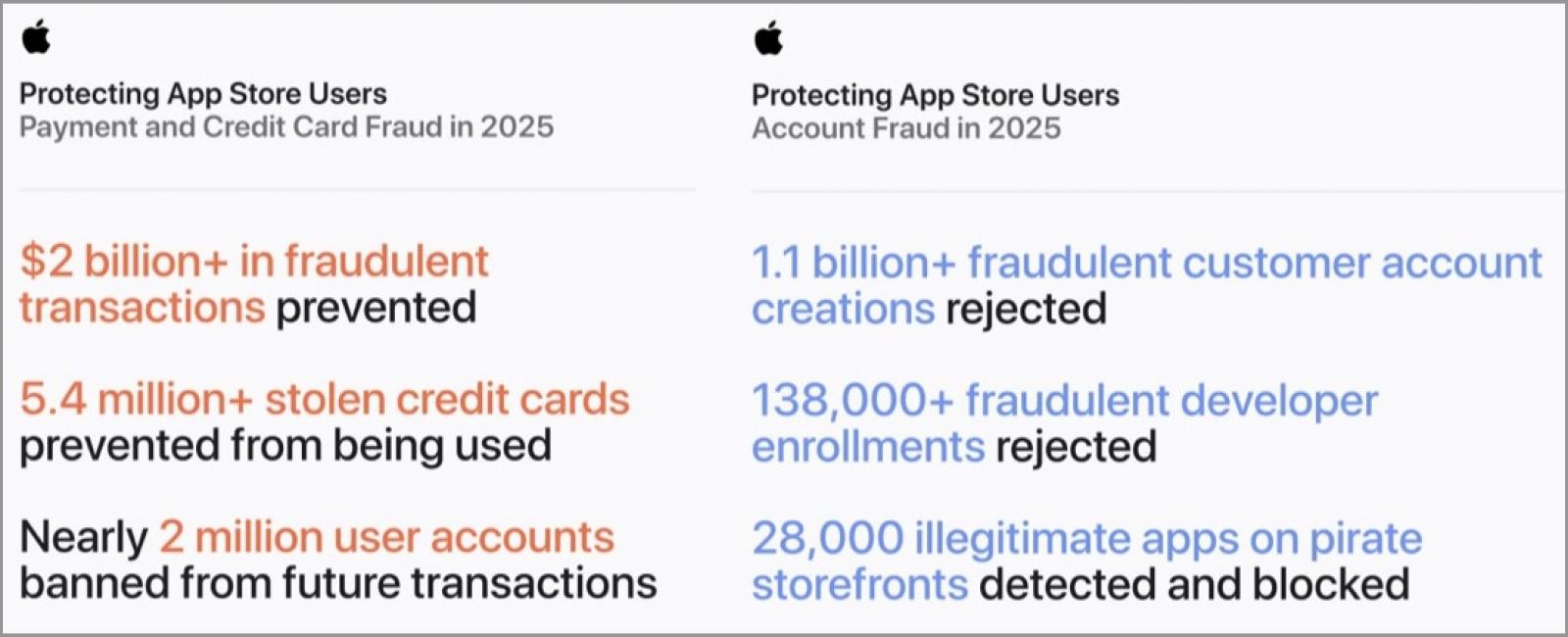
*Apple App Store fraud statistics 2025*
### App Review and Content Moderation
**Apple**'s **App Review** team evaluated over 9.1 million app submissions in 2025, a notable increase from 7.7 million the previous year. The company rejected a significant number of apps for various reasons, including:
* Over 443,000 for privacy violations.
* Over 371,000 for being copycats or misleading apps.
* More than 22,000 for containing hidden or undocumented features.
Additionally, nearly 59,000 apps were removed from the **App Store** for bait-and-switch tactics, a substantial increase from the 17,000 removed in 2024.
### Combating Deceptive Practices
**Apple** also focused on combating deceptive practices such as fraudulent ratings and reviews. In 2025, the company processed more than 1.3 billion ratings and reviews, blocking nearly 195 million fraudulent submissions.
Furthermore, **Apple** prevented nearly 7,800 deceptive apps from appearing in search results and blocked 11,500 from **App Store** charts. The company also detected and blocked 28,000 illegitimate apps on pirate storefronts.
With over 850 million weekly visitors across 175 storefronts worldwide, **Apple** advises customers to report any suspicious activity in apps downloaded from the **App Store** immediately at [reportaproblem.apple.com](https://reportaproblem.apple.com/).
## [The Validation Gap: Automated Pentesting Answers One Question. You Need Six.](https://hubs.li/Q048zztN0)
Automated pentesting tools deliver real value, but they were built to answer one question: can an attacker move through the network? They were not built to test whether your controls block threats, your detection rules fire, or your cloud configs hold.
This guide covers the 6 surfaces you actually need to validate.
[Download Now](https://hubs.li/Q048zztN0)