Beyond Identity: Why Device Security Must Share the Cybersecurity Load
Identity-centric security is cracking under the pressure of sophisticated phishing and AI-powered attacks. A valid credential no longer guarantees a safe connection in today's complex IT environments. Real-time device checks are crucial to verifying the trustworthiness of a session, even after successful authentication.


Identity has long been considered a cornerstone of cybersecurity, but its ability to stand alone is diminishing. As threat actors increasingly leverage AI and sophisticated phishing techniques, the traditional approach of simply verifying employee identity is proving insufficient. The rise of SaaS, BYOD policies, and hybrid work models means a valid credential no longer automatically equate to a secure connection.
## The Post-Authentication Blind Spot
While multi-factor authentication (MFA) was designed to bridge this gap, modern phishing kits now allow attackers to intercept and proxy authentication in real-time, stealing session tokens even after successful MFA completion. The victim unknowingly completes all security checks, while the attacker gains access with a valid session cookie.
**NIST Special Publication 800-207**, the foundation for Zero Trust architecture, foresaw this challenge. It emphasizes the need to move beyond implied trust after initial authentication and to incorporate device security posture into access decisions.
In practice, many organizations still treat authentication as a one-time event. Identity is verified, MFA is passed, and a session begins, with trust maintained until the token expires. Critically, a session token in an attacker's browser appears identical to one in the user's browser, making traditional authentication logs unable to differentiate between them.
## Where Zero Trust Breaks Down
Many Zero Trust implementations prioritize identity, focusing on strengthening authentication, enforcing MFA, reducing password reliance, and implementing risk-based sign-in policies. Device verification, however, is often inconsistently applied, frequently stopping at login or limited to browser-based workflows within conditional access frameworks. Legacy protocols, remote access tools, and API integrations often inherit trust implicitly once identity is established.
This creates a fragmented security model. Personal and third-party devices may be loosely controlled or entirely unmanaged. Session trust persists even if device posture degrades mid-session. Identity signals and endpoint signals reside in separate tools with limited integration. Identity is heavily scrutinized at login, but access is rarely reassessed in a meaningful way.
## The Device: The Missing Piece
A stolen password used from an attacker-controlled laptop should not be treated the same as the same password used from a compliant, encrypted corporate endpoint. However, this is precisely what happens when access is solely governed by identity.
Device posture provides critical information that identity alone cannot. Is the device encrypted? Is endpoint protection active and up-to-date? Is the operating system patched? Has the configuration deviated from policy? Is this approved hardware?
Crucially, these answers must remain current throughout the entire session. Updates can be delayed, endpoint protection can be disabled, and unauthorized software can be installed. Conditions at login are not necessarily the same as conditions later in the session. Continuous device verification reduces the value of stolen credentials and intercepted tokens by binding access not only to identity but also to a trusted, healthy endpoint.
## Four Principles for a Stronger Model
A more robust approach combines identity with continuous device verification. This translates into the following practices:
1. **Continuously verify both the user and the device:** Access should be conditional on device health, not just identity. Real-time adjustments to trust levels should occur if endpoint protection is disabled or encryption is turned off mid-session. This effectively mitigates the risks associated with stolen credentials, token replay, MFA fatigue, and attacker-controlled endpoints.
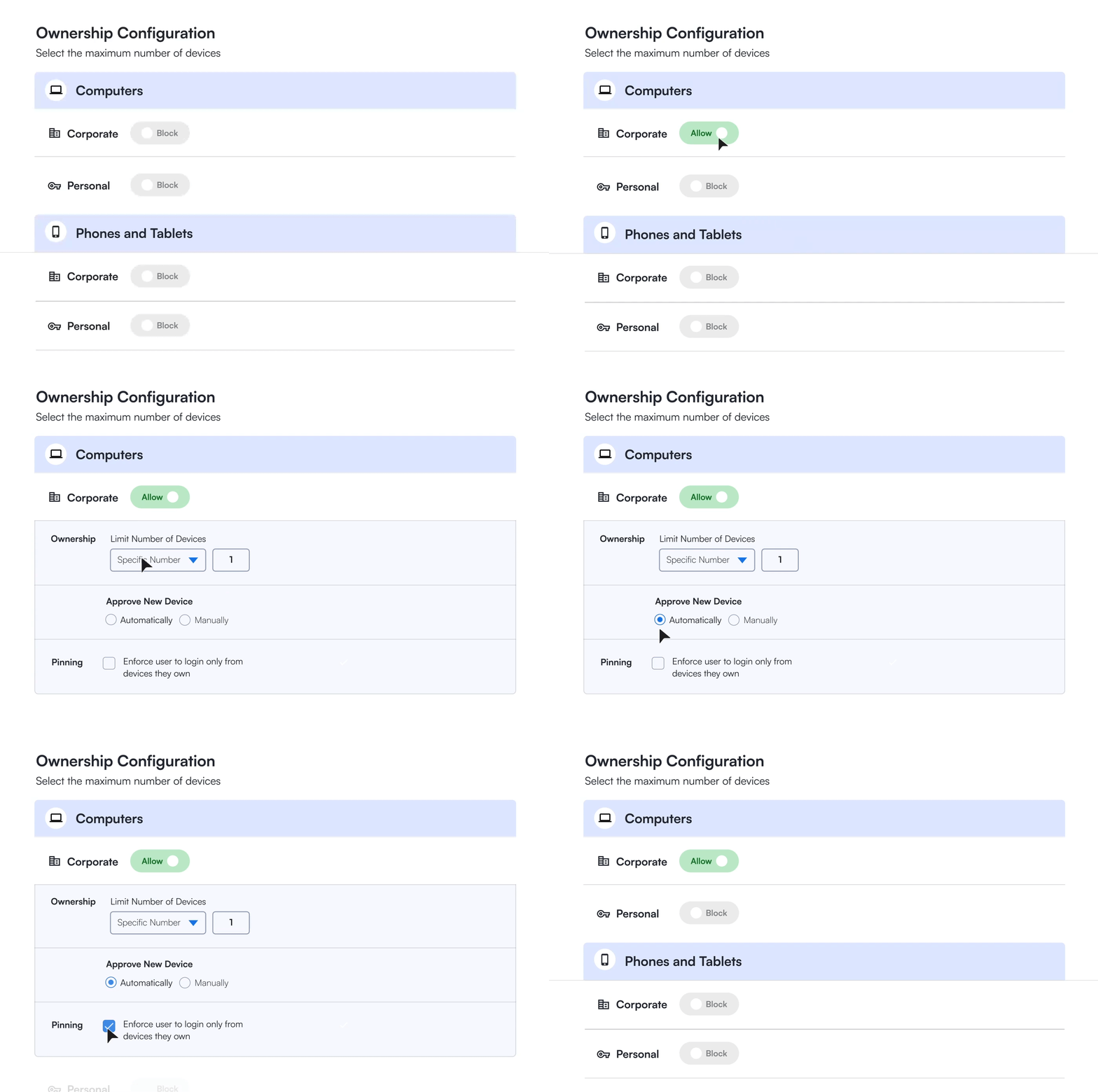
2. **Bind access to approved hardware:** Implement device-based controls to enroll trusted hardware and differentiate between corporate, personal, and third-party endpoints. Valid credentials used from an unrecognized device should not grant access simply because MFA was successful.
3. **Apply proportionate enforcement:** Avoid rigid controls that lead to workarounds. A mature posture strategy can apply conditional restrictions, reduced privileges, or time-bound grace periods instead of defaulting to hard blocks. This balance is crucial for hybrid and remote teams.
4. **Enable self-service remediation:** If trust is tied to device health, users need a way to restore that trust. Guided fixes for encryption, OS updates, or endpoint protection empower employees to resolve posture issues without requiring IT intervention or losing access unnecessarily.
Solutions like **Specops Device Trust** operationalize this model by extending trust decisions beyond identity and maintaining enforcement as conditions change. It continuously authenticates users and verifies their devices across Windows, macOS, Linux, and mobile platforms, not just at login.
Identity remains important, but it can no longer bear the entire weight of access decisions alone.