Russian Authorities Accuse Journalist of Aiding Cyberattacks Against Russia
Russian authorities have detained a former freelance journalist for **Radio Free Europe**, accusing him of treason for allegedly providing information to Ukraine that facilitated cyberattacks against Russian targets. The **Federal Security Service (FSB)** claims the journalist shared data about critical infrastructure and a local publication covering the war, which was then used to assist cyber operations.
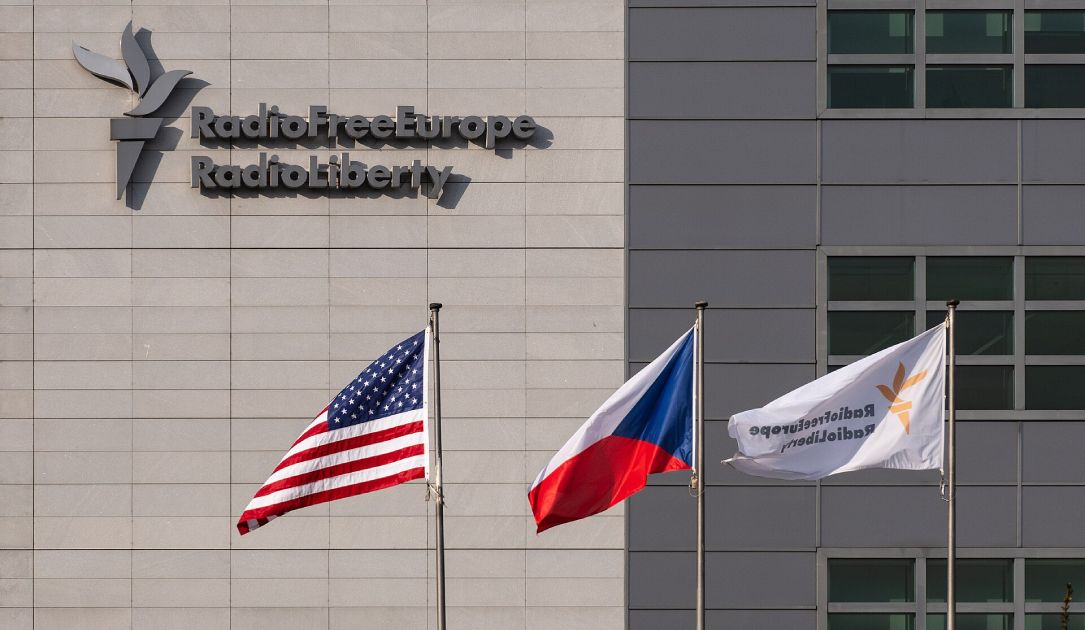
Russian authorities detained a former freelance journalist for Radio Free Europe on treason charges, accusing him of passing information to Ukraine that allegedly aided cyberattacks against Russian targets, the country’s **Federal Security Service (FSB)** said Thursday.
In a [statement](https://tass.ru/proisshestviya/27051473) to state-owned media, the FSB said the suspect joined a **Telegram** channel controlled by the Security Service of Ukraine (**SBU**) and passed information about a local print publication covering Russia’s war in Ukraine, as well as data about a critical infrastructure facility in the region. Authorities said the information was used to assist cyberattacks.
The suspect was placed in pre-trial detention after security officers searched his home and seized computer equipment and communication devices that the FSB said contained evidence of activities “directed against the security of Russia.”
The FSB did not name the detainee. However, the independent Russian outlet 7x7 [reported](https://t.me/horizontal_russia/54352) that the case likely involves 65-year-old Alexander Andreyev, a journalist from the Zabaykalsky region who worked with several local media outlets and was a contributor to Radio Free Europe in the early 2010s.
Russian security services [claimed](https://iz.ru/2075585/2026-04-09/v-zabaikale-zaderzhali-za-gosizmenu-eks-korrespondenta-radio-svobodnaia-evropa?ysclid=mnr4kqbuar70784053) the suspect had cooperated with what authorities described as “anti-Russian human rights organizations” and, after the start of the war with Ukraine, “took a clearly pro-Ukrainian position.”
Radio Free Europe has not publicly commented on the detention.
In 2020, Russia’s Justice Ministry designated **Radio Liberty** a “foreign agent,” and in 2025 prosecutors declared the outlet an “undesirable organization,” effectively banning its activities in Russia. Radio Free Europe/Radio Liberty, an American state-funded broadcaster, was originally founded with a focus on Soviet satellite states.
Also on Thursday, Russian security services searched the newsroom of **Novaya Gazeta** in Moscow, the newspaper said in the [statement](https://novayagazeta.eu/articles/2026/04/09/russian-security-forces-raid-novaya-gazeta-office-in-moscow-news). Authorities have not disclosed the reason for the search.
A law enforcement source cited by state news agency RIA Novosti [said](https://t.me/rian_ru/336696) the operation was linked to an investigation into the illegal use of personal data. Another source [told](https://tass.ru/obschestvo/27055631) the agency TASS that investigators were examining whether Novaya Gazeta had ties to **Novaya Gazeta Europe** — an outlet designated “undesirable” in Russia — and the Anti-War Committee of Russia, which Moscow has labeled a terrorist organization.
## Eyes on Telegram
The Radio Free Europe case is the latest in a series of criminal investigations tied to activity on the Telegram messaging app.
Earlier this month, Russian security forces in the occupied city of Sevastopol [detained](https://zmina.info/ru/news-ru/v-sevastopole-okkupaczionnye-siloviki-zaderzhali-muzhchinu-iz-za-soobshhenij-v-telegram/) a resident suspected of making alleged calls for terrorism and extremism through the platform.
Since February, Russian authorities have [opened](https://novayagazeta.eu/articles/2026/04/05/dela-za-zvezdy) at least three criminal cases linked to Telegram’s virtual currency feature, **Telegram Stars**, which investigators say was used to financially support organizations banned in Russia, including the Freedom of Russia Legion — a unit of Russian fighters aligned with Ukrainian forces.
In another case last November, Russian authorities [arrested](https://therecord.media/russia-arrests-tech-entrepreneur-treason) a 21-year-old tech entrepreneur and cybersecurity specialist in Moscow on treason charges after he criticized the government’s anti-cybercrime legislation and a state-backed messaging app known as **Max** on his Telegram channel.
Russian officials have increasingly sought to restrict Telegram, which remains widely used in the country. Telegram founder **Pavel Durov** [said](https://t.me/durov/477) last week that despite the Kremlin’s attempts to block or limit the service, roughly 65 million Russians continue to use the app daily, often through virtual private networks.
“The entire nation is now mobilized to bypass these absurd restrictions,” Durov said in a statement. “On our end, we’ll keep adapting — making Telegram’s traffic harder to detect and block.”

