Bulletproof Hosting Service Virtualine Seized in Major International Cybercrime Takedown
An international law enforcement operation has successfully seized the primary domain of **Virtualine**, a prominent bulletproof hosting service. Advertised on cybercrime forums, **Virtualine** facilitated a wide range of illicit activities, from ransomware attacks and phishing to the distribution of child abuse material. The takedown marks a significant blow to the infrastructure supporting global cybercriminal operations.

U.S. law enforcement, in a concerted international effort, has announced the seizure of **Virtualine**, a notorious bulletproof hosting service. Operating under various aliases including **Secury**, **Massgod**, **Spamhouse**, **Lanedo**, and **Omegatech**, the service explicitly marketed itself on cybercrime forums as a shield against legal scrutiny and law enforcement requests.
### Facilitating Black Hat Activities
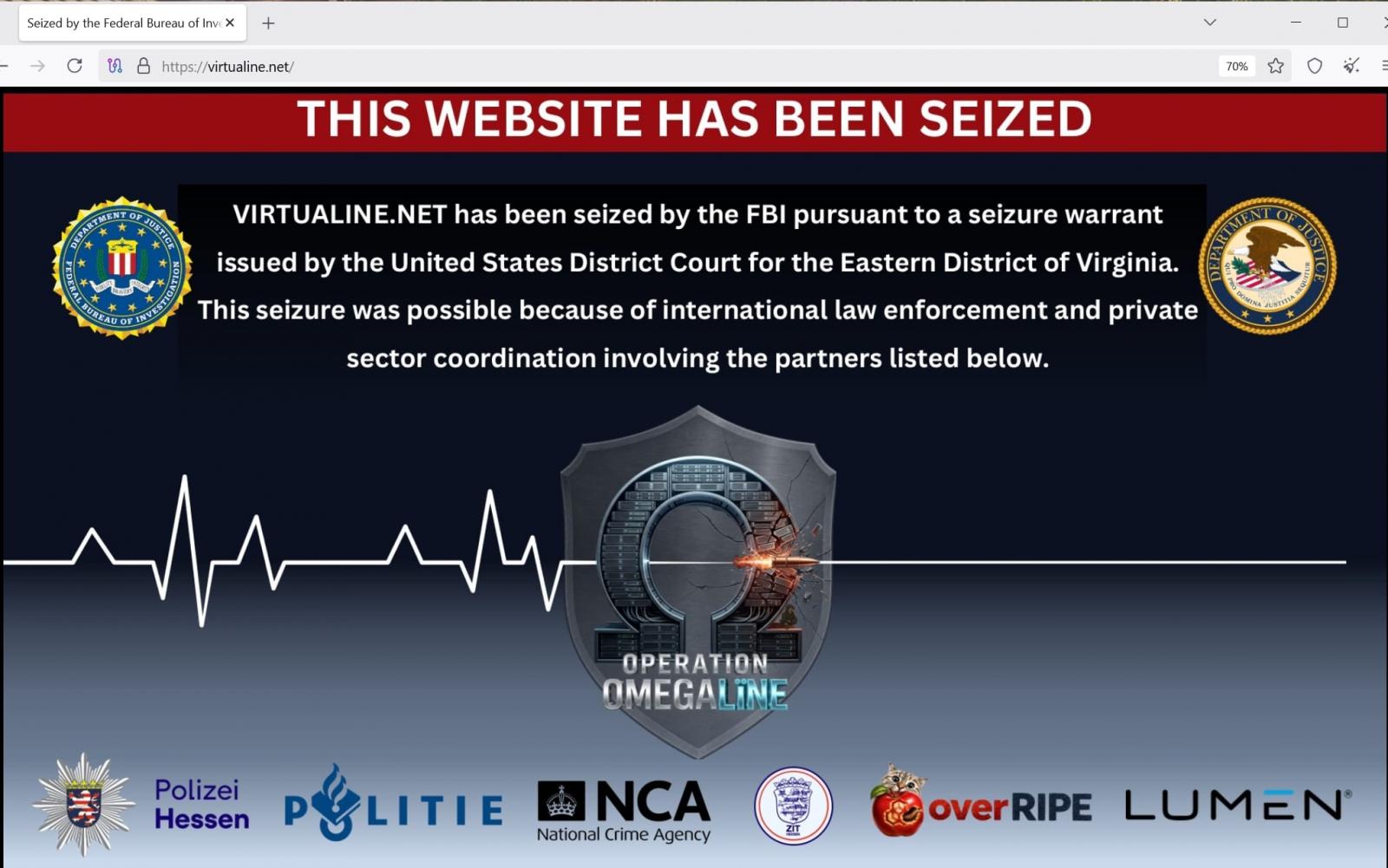
The **U.S. Department of Justice (DOJ)** confirmed that **Virtualine**'s services were openly advertised for "illegal/black hat activities." These included phishing, spamming, carding, and port scanning. The **FBI** led the primary domain seizure of `virtualine.net`, an investigation that involved global partners such as Germany’s **Polizei Hessen**, the Netherlands’ **Politie Midden-Nederland**, and the U.K.’s **National Crime Agency**, alongside private partners **OverRIPE** and **Lumen**.

### Disturbing Allegations of Child Abuse Material Hosting
Despite claiming to draw a line at child content, authorities allege that **Virtualine** knowingly hosted an online forum promoting child abuse material. The operator reportedly ignored repeated notices from law enforcement, the **National Center for Missing and Exploited Children (NCMEC)**, and a victim’s attorney. As legal pressure mounted, **Virtualine** allegedly collaborated with administrators to establish a new site, which, according to the **DoJ**, continues to host such material and has already received new abuse complaints.
In response, an administrator of **Virtualine** published an open letter on a new website, `virtualine.org` (captured by cybersecurity firm **Silent Push**), rejecting the child abuse allegations while acknowledging that claims of illegal activities "deserve a fair investigation."
### Integral to the Cybercrime Ecosystem
**Virtualine**'s business model included accepting direct Bitcoin payments, effectively laundering proceeds from various cybercriminal enterprises. **Chainalysis**, a blockchain intelligence firm, provided crucial intelligence, linking **Virtualine**'s payment addresses directly to ransomware operators, infostealer infrastructure, Russian-language cybercrime forums, illicit shops, scams, and phishing platforms.
"**Virtualine** accepted direct bitcoin payments through unhosted wallet addresses, allowing criminal customers to pay without flagging their funds through hosted exchange compliance programs," **Chainalysis** noted, adding that **Virtualine** then laundered these proceeds to conceal their origin.
Another blockchain intelligence firm, **TRM Labs**, reported that ransomware groups accounted for 5% of **Virtualine**’s financial flows, with a significant 44% originating from a Russian drug marketplace. Major sextortion schemes and mixers also contributed substantial funds.
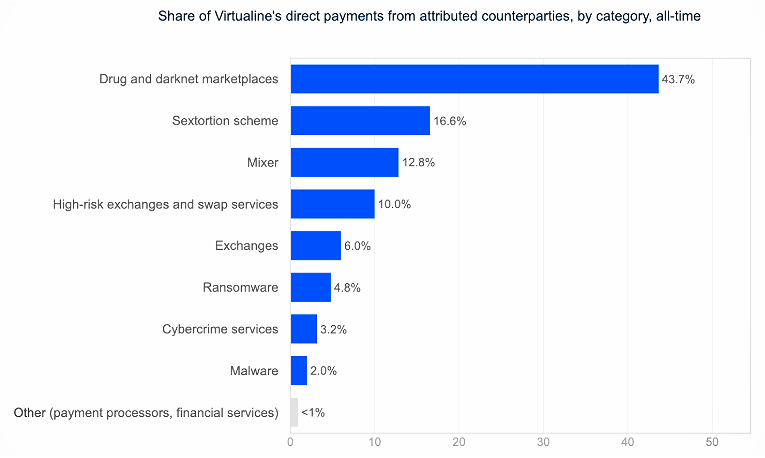
**TRM Labs** also identified consistent financial ties between **Virtualine** and the **StealC** infostealer this year.
### Physical Infrastructure Seized, Customer Data Recovered
The Dutch police confirmed the seizure of dozens of physical servers in Limburg, effectively taking hundreds of virtual servers offline. Investigators also recovered data from over 3,000 **Virtualine** customers, with follow-up actions against them now underway. Authorities in the Netherlands indicate that the platform had been facilitating cybercrime operations, including ransomware, botnets, infostealers, phishing, and child abuse material distribution, since at least 2022.
While **Virtualine** may remain partially online, researchers have observed significantly reduced network routing visibility, suggesting that much of its core infrastructure is no longer reachable. This international collaboration underscores the growing effectiveness of law enforcement in disrupting critical components of the cybercriminal ecosystem.