Critical Nginx UI Authentication Bypass Under Active Exploitation: CVE-2026-33032
A critical vulnerability, **CVE-2026-33032**, in **Nginx UI** with Model Context Protocol (MCP) support is being actively exploited in the wild. This flaw allows unauthenticated remote attackers to gain full server takeover by invoking privileged MCP actions without needing credentials.


## Unauthenticated Takeover via Nginx UI
The vulnerability, **CVE-2026-33032**, exists because **nginx-ui** leaves the `/mcp_message` endpoint unprotected. This allows remote attackers to invoke privileged MCP actions without authentication.
Because these actions involve writing and reloading **Nginx** configuration files, a single unauthenticated request can modify server behavior, effectively granting complete control over the web server.
> "[...] any network attacker can invoke all MCP tools without authentication, including restarting nginx, creating/modifying/deleting nginx configuration files, and triggering automatic config reloads – achieving complete nginx service takeover,” reads **NIST's** description of the flaw in the National Vulnerability Database (NVD).
## Patch Released, Exploitation in the Wild
**NGINX** released a fix for the flaw in version 2.3.4 on March 15th, a day after researchers at **Pluto Security AI** reported it. However, the vulnerability identifier, along with technical details and a proof-of-concept (PoC) exploit, emerged at the end of the month.
In a recent CVE Landscape report, threat intelligence company **Recorded Future** notes that **CVE-2026-33032** is currently under active exploitation.
**Nginx UI** is a popular web-based management interface for the **Nginx** web server, boasting over 11,000 stars on GitHub and 430,000 Docker pulls.
## Exposure and Attack Vectors
According to **Pluto Security's** internet scans using the **Shodan** engine, approximately 2,600 publicly exposed instances are potentially vulnerable. The majority of these are located in China, the United States, Indonesia, Germany, and Hong Kong.
In a report, **Pluto Security's** Yotam Perkal details that exploitation requires only network access. It involves establishing a Server-Sent Events (SSE) connection, opening an MCP session, and then using the returned `sessionID` to send requests to the `/mcp_message` endpoint.
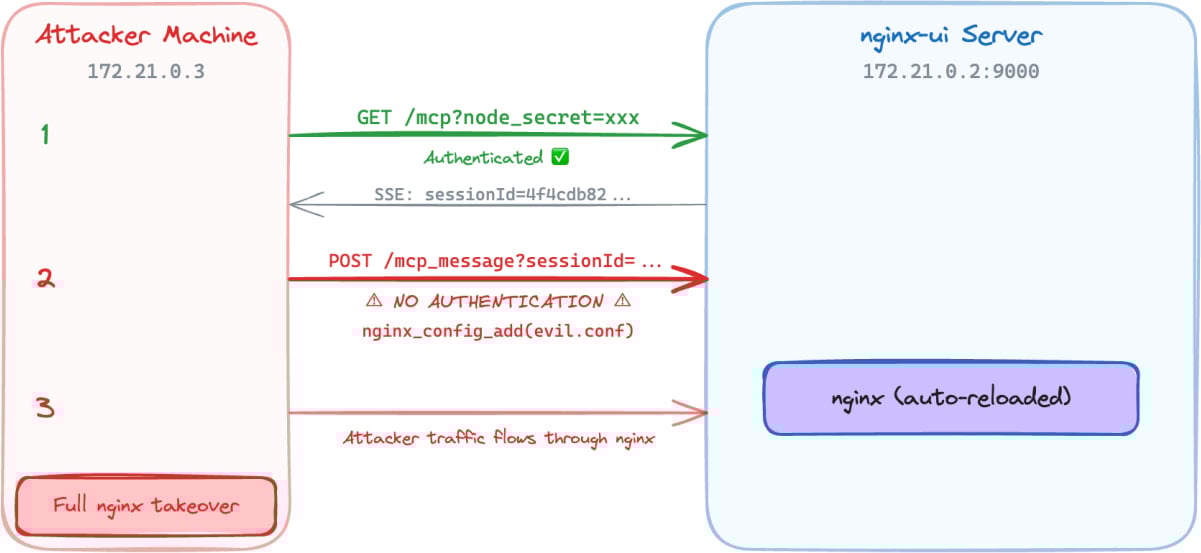
From this point, attackers can invoke MCP tools without authentication to:
* Connect to the target nginx-ui instance
* Send requests without any authentication headers
* Gain access to all 12 MCP tools (7 destructive)
* Read nginx configuration files and exfiltrate them
* Inject a new nginx server block with malicious configuration
* Trigger automatic nginx reload
**Pluto Security's** demo illustrates how an attacker can leverage the unauthenticated MCP message endpoint to execute privileged nginx management actions, perform config injection, and ultimately gain control of the **Nginx** server, all without authentication.
## Mitigation
Given the active exploitation and the public availability of PoCs, system administrators are strongly advised to apply the available security updates immediately. The latest secure version of **nginx-ui** is 2.3.6, released last week.