California Advances Controversial 3D Print Surveillance Bill Despite EFF Warnings
The California State Assembly has approved legislation mandating surveillance software in 3D printers, despite strong opposition from the **Electronic Frontier Foundation (EFF)**. Critics argue that the bill, **AB 2047**, fails to address fundamental privacy and free speech concerns while imposing impractical and ineffective technical requirements on users and manufacturers.
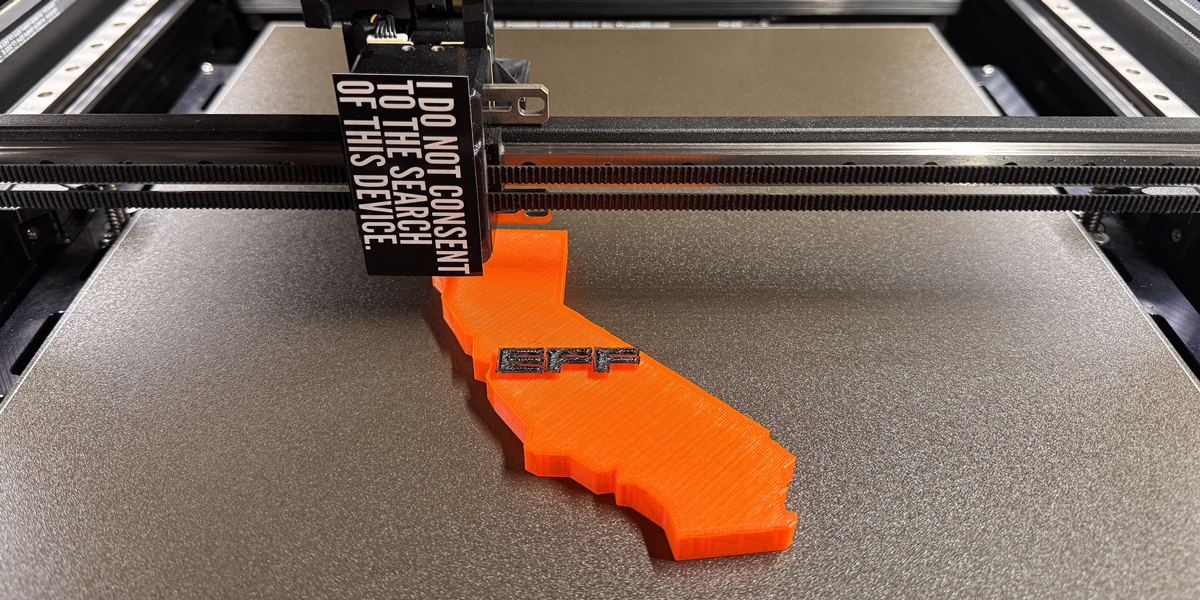
Ignoring persistent warnings from the **EFF** regarding the dangers and technical impossibilities of implementing a new mandate for 3D print surveillance software, the California State Assembly has signed off on **AB 2047**. In doing so, legislators have amended the bill, making it even more confusing and failing to adequately address the risks to privacy, speech, and consumer rights. A renewed call is being made for legislators to drop this bill as it heads to the state senate, protecting the tools of creators across California.
## What's Changed About the Bill?
Since its initial introduction, **AB 2047**, a bill targeting 3D printers for the rare, impractical, and already illegal practice of manufacturing firearms without a license, has undergone several amendments. While some changes are welcome, most have only highlighted the technocratic absurdity of the proposed scheme. The core concerns—that this mandate censors lawful speech, builds out corporate surveillance, and criminalizes open-source experimentation—remain unaddressed.
### Removes Criminalization of Resale
One silver lining in the current bill is a carve-out for the private resale of devices. The original bill would have made it a criminal offense for individuals to resell 3D printers purchased before the mandated censorship and surveillance software was in place. This represents a clear win for the 3D-printing community, though it is not enough to remedy the bill's fundamental flaws.
### Ineffective Carve-outs for Open Source
One of the most dangerous aspects of **AB 2047** is its potential to criminalize individual users for common practices, such as creating and using alternative open-source programs with their 3D printers. New amendments offer a carve-out for open-source tools, but only if they include compliant censorship software. This provision burdens open-source developers with ambiguous and unrealistic standards for print blocking, creating a chilling effect for open-source users.
### Removes Any Actual Requirement to Work
It is critical to reiterate that there is no scenario where the mandated technology will actually work as intended. It will inevitably block lawful use of 3D printers while failing to prevent determined individuals from printing firearms. No amendment can change this technical reality.
Instead, the current bill simply drops the pretense that this mandate is expected to be effective. The performance standard for algorithms has been downgraded from "effectively prevent[ing] a technically skilled user from evading [the algorithm]" to "substantially reduce the likelihood of foreseeable circumvention attempts..." The bill will still require all prints to be surveilled, but instead of testing efficacy against a skilled user, it now aims to play a futile game of whack-a-mole with the literally infinite number of circumventions any user can employ.
Furthermore, the bill now establishes an unclear process that relies on non-governmental third parties to define standards and places the burden of self-policing on manufacturers and resellers.
### Hollywood Gets a Cut
The bill includes another carve-out, this time for commercial users within the entertainment industry, which extensively uses 3D printers for props and costumes.
While this may benefit large studios, it unfortunately excludes indie filmmakers, cosplayers, and countless other small creators. This appears to be a defensive edit designed to limit corporate opposition rather than a thoughtful policy decision. There is no clear division in 3D printing between consumer and commercial tools; these are general-purpose devices used by everyone from large prop departments to artists preparing for **Comic Con**.
Commercial carve-outs empower printer manufacturers to sell a more expensive tier of printers, locking in and up-charging their commercial customers. Some of these customers may opt for general retail versions, but that comes with its own price: increased risk of intellectual property theft as all printed files are surveilled in the same manner as for hobbyists. This presents a tangible risk of businesses leaking prototypes or new designs not only to the printer manufacturer but potentially to snooping governments or the general public through data breaches.