Certighost: Unmasking the Hidden Privilege in Active Directory Certificate Services
A new vulnerability, dubbed **Certighost** (**CVE-2026-54121**), has exposed a critical flaw in **Microsoft's Active Directory Certificate Services (AD CS)**, allowing low-privileged users to escalate to Domain Controller status. This attack leverages a trust-validation failure, highlighting the dangers of neglected defaults and hidden privileges within enterprise environments.

Every mature **Active Directory** environment relies on a **Certification Authority (CA)**, a component that silently holds immense power. When a CA signs a certificate, every machine, service, and authentication flow within the domain implicitly trusts that signature. This concentration of trust, often treated as a set-and-forget utility, has been starkly reminded of its criticality by **Certighost**.
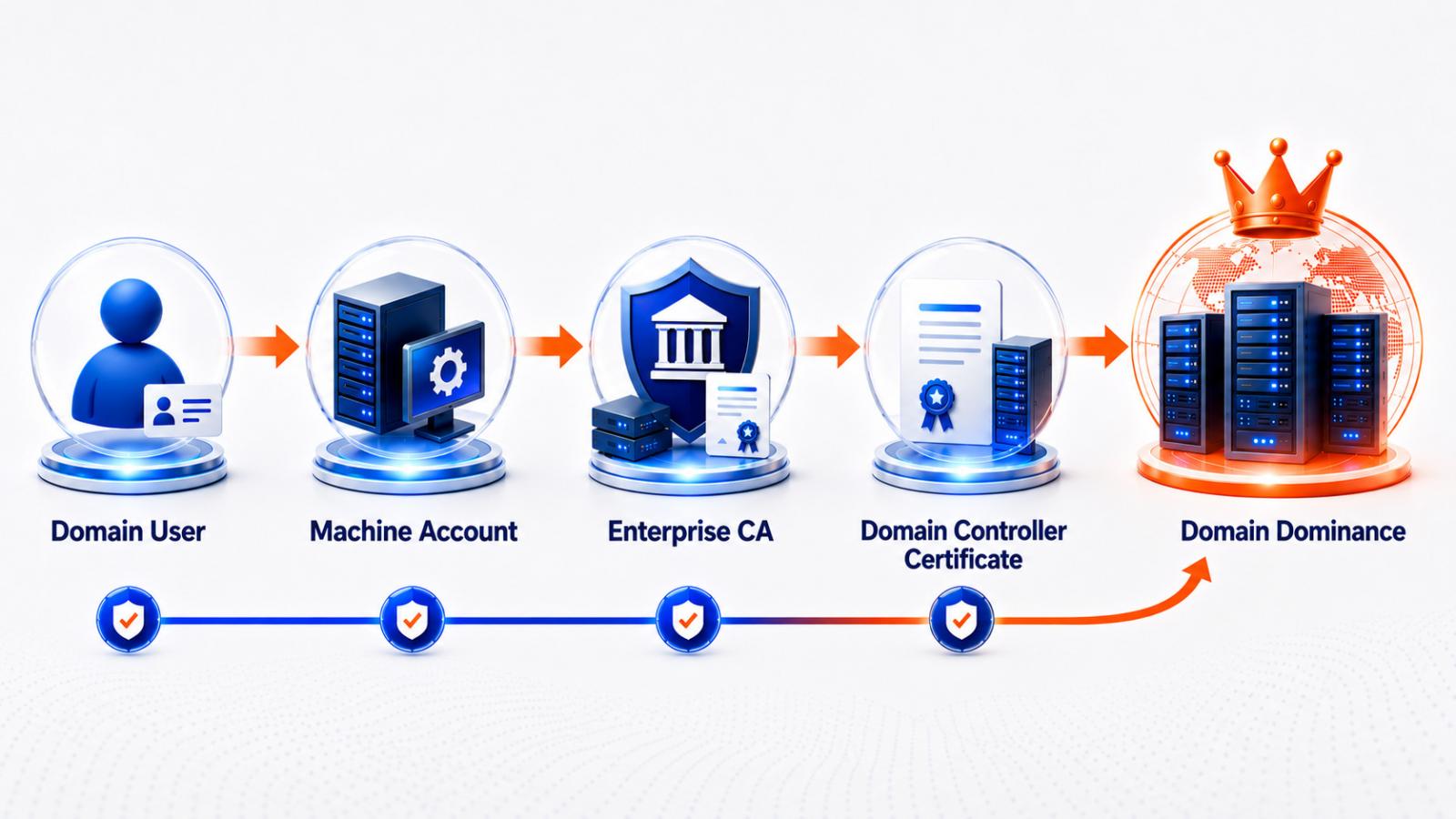
Tracked as **CVE-2026-54121**, **Certighost** demonstrates a method for a standard, low-privileged **Active Directory** user to coerce an Enterprise CA into issuing a valid authentication certificate for a **Domain Controller**. This certificate can then be used to assume the identity of the **Domain Controller** itself. A working proof-of-concept was publicly disclosed on July 24, 2026, just ten days after **Microsoft** released a fix on July 14, 2026, rating the vulnerability 8.8 on the CVSS scale.
## Understanding the Certighost Attack
**Active Directory Certificate Services (AD CS)** is **Microsoft's** public key infrastructure, responsible for issuing and managing certificates crucial for smart card logon, device and user authentication, and VPN access. Ordinarily, a standard domain user should never be able to obtain a certificate representing a **Domain Controller**. **Certighost** bypasses this boundary without altering any access control lists.
The flaw resides in an **AD CS** enrollment behavior known as "chase" functionality. When an Enterprise CA cannot immediately resolve a target object locally, it can follow requester-supplied routing information (a parameter called `cdc`) to look up the object elsewhere.
The critical defect is that the CA fails to verify the legitimacy of the endpoint named in `cdc` before connecting to it. An attacker can point `cdc` at a machine they control, prompting the CA to connect to this rogue endpoint. This malicious endpoint then responds with forged identity data, including the target **Domain Controller's** object security identifier and DNS host name.
The CA, trusting the information provided, binds this forged identity to a signed X.509 certificate and issues it to the attacker, effectively granting them a certificate that authenticates them as a **Domain Controller**.
From this point, the attack proceeds along a familiar path. The attacker uses the certificate with **PKINIT**, the public key extension to **Kerberos**, to obtain a Ticket Granting Ticket (TGT) for the **Domain Controller's** machine account. **Domain Controller** accounts inherently possess directory replication rights, which are sufficient to perform a **DCSync** operation against a real DC. This allows the attacker to pull credential material, including the `krbtgt` account hash. Possession of the `krbtgt` hash enables the attacker to forge **Kerberos** tickets at will, effectively compromising the entire domain.
Testing confirmed that a standard **Domain User** account was sufficient for the attack, as default **Active Directory** settings, including the default `MachineAccountQuota` (which allows ordinary users to create machine accounts), provided all necessary prerequisites.
While no in-the-wild exploitation has been confirmed as of public disclosure, the existence of a functional, public proof-of-concept drastically reduces the effort required for reproduction. The gap between a PoC and commodity tooling is typically measured in weeks, not years.
## More Than a Certificate Bug: A Trust and Privilege Failure
It's tempting to categorize **Certighost** as a niche PKI issue, patch it, and move on. However, stripping away the technical details reveals a fundamental identity security problem: an unprivileged identity manipulated a trusted system into vouching for a privileged identity, with no mechanism in place to question the result. This is a critical trust-validation failure.
The **Certification Authority** is not a passive appliance; it is a privileged identity that actively manufactures trust for the entire domain. The **Microsoft** patch primarily introduces a verification step to ensure the target of a chase lookup is genuinely a **Domain Controller**.
This pattern is characteristic of identity-driven compromises: attackers rarely break cryptography or authentication directly. Instead, they exploit areas where systems implicitly trust without sufficient verification.
A second, more concerning lesson lies in the prerequisites. Default **Active Directory** configurations grant every authenticated user a small, often overlooked, piece of standing privilege: the ability to create machine accounts, thanks to a default `MachineAccountQuota`. **Certighost** is one of many attack chains that quietly leverage this inherent capability. While the **CVE** is new, the underlying latent privilege has been present in many domains for years.
**Certighost** created a shortcut, but the underlying terrain was already vulnerable. A determined attacker with a low-privileged foothold can achieve domain dominance because privilege has accumulated in unmanaged areas: overly broad certificate template permissions, permissive machine account defaults, flat trust between the CA and the domain, and monitoring focused on endpoints rather than the identity control plane.
**Certighost** vividly demonstrates how these conditions compound. Even if the **CVE** is removed, the underlying exposure remains, awaiting the next exploit technique.
## Actionable Steps for Mitigation
**1. Patch Immediately:** Apply **Microsoft's** July 14, 2026 update to all issuing **Certification Authorities**. This patch introduces the crucial destination validation that prevents the specific chase abuse.
**2. Consider Workarounds (with caution):** If immediate patching is not feasible, researchers have documented a workaround that disables the vulnerable chase functionality. However, thoroughly test this before deployment, as it may disrupt legitimate enrollment workflows.
**3. Reduce Standing Privilege:** Set the domain's `MachineAccountQuota` to zero. This removes the default ability for ordinary users to create machine accounts, significantly shrinking the attack surface for this class of techniques. Be aware that this change may impact some provisioning workflows and legacy tooling, so inventory dependencies and route machine creation through controlled, delegated accounts.
**4. Constrain the CA:** Restrict outbound SMB and LDAP from your **Certification Authorities** to only communicate with known, authorized **Domain Controllers**. This directly thwarts the rogue-endpoint step in the attack chain.
**5. Review CA Deployments and Permissions:** Audit Enterprise CA deployments, certificate templates, and enrollment permissions. Determine which principals can request specific certificates and whether that population genuinely needs the identity represented by those certificates. Many environments have not audited certificate enrollment rights against this standard, which is a common origin for **AD CS** attack paths.
**6. Monitor the Right Layer:** Implement monitoring for anomalous machine account creation, unusual certificate enrollment activity, and **DCSync** operations. Pay close attention to CA enrollment events rather than relying solely on endpoint telemetry, which is often not designed to detect identity attacks. Any **DCSync** operation originating from anything other than a **Domain Controller** warrants an immediate response. If your current detection stack cannot surface this, address that gap promptly.
## The Enduring Lesson
**Certighost** will likely be patched, cataloged, and eventually fade from immediate memory. This is the trap. The true takeaway is not just the specific vulnerability, but the broader implications of neglected privilege, unvalidated trust, and the cumulative risk of default configurations. Addressing these underlying issues is paramount to building a resilient identity security posture.