Check Point Rushes Emergency Patch for Actively Exploited Security Management Server Vulnerability
Check Point Software has issued an urgent hotfix to address a critical path traversal vulnerability, tracked as **CVE-2026-93616**, affecting its Security Management Server. This flaw allows unauthenticated attackers to upload and execute arbitrary scripts, with the company confirming active exploitation in the wild.
Cybersecurity firm **Check Point Software** has released an emergency hotfix to mitigate a critical vulnerability in its Security Management Server. This flaw, identified as **CVE-2026-93616**, is a path traversal weakness that could enable unauthenticated attackers to upload and execute arbitrary scripts on affected systems.
The **Security Management Server** serves as a central hub for storing and managing security policies, processing administrative changes, and consolidating system logs across enterprise networks. Its critical role makes any compromise a significant threat to an organization's security posture.
### The Vulnerability: CVE-2026-93616
**CVE-2026-93616** is described as a low-complexity attack vector where unauthenticated threat actors can exploit the path traversal flaw to upload arbitrary scripts. These scripts can then be executed on vulnerable **Check Point Management Servers**.
This type of vulnerability has been a long-standing concern within the cybersecurity community. The **Cybersecurity and Infrastructure Security Agency (CISA)** and the **FBI** have consistently urged software developers since May 2024 to eliminate path traversal weaknesses from their products, highlighting that such issues have been deemed 'unforgivable' since as early as 2007.
### Affected Products and Patches
**Check Point** has addressed **CVE-2026-93616** in its **R82.20 Security Hotfix**. The comprehensive list of affected products includes the Security Management Server, Multi-Domain Security Management Server, Log Server, Multi-Domain Log Server, and SmartEvent.
### Active Exploitation and Mitigation
The company has confirmed that the vulnerability is being actively exploited, stating, "This vulnerability is exploited in the wild. Check Point is aware of a handful of customers who have been attacked." Security teams are strongly advised to review their networks for indicators of compromise (IoCs) detailed in **Check Point**'s security advisory.
For organizations unable to immediately deploy the hotfix, **Check Point** has provided temporary mitigation strategies. These include hardening vulnerable systems by placing them behind a firewall and restricting access to trusted IP addresses. This can be configured within the SmartConsole dashboard under `Manage & Settings > Permissions & Administrators > Trusted Clients`.
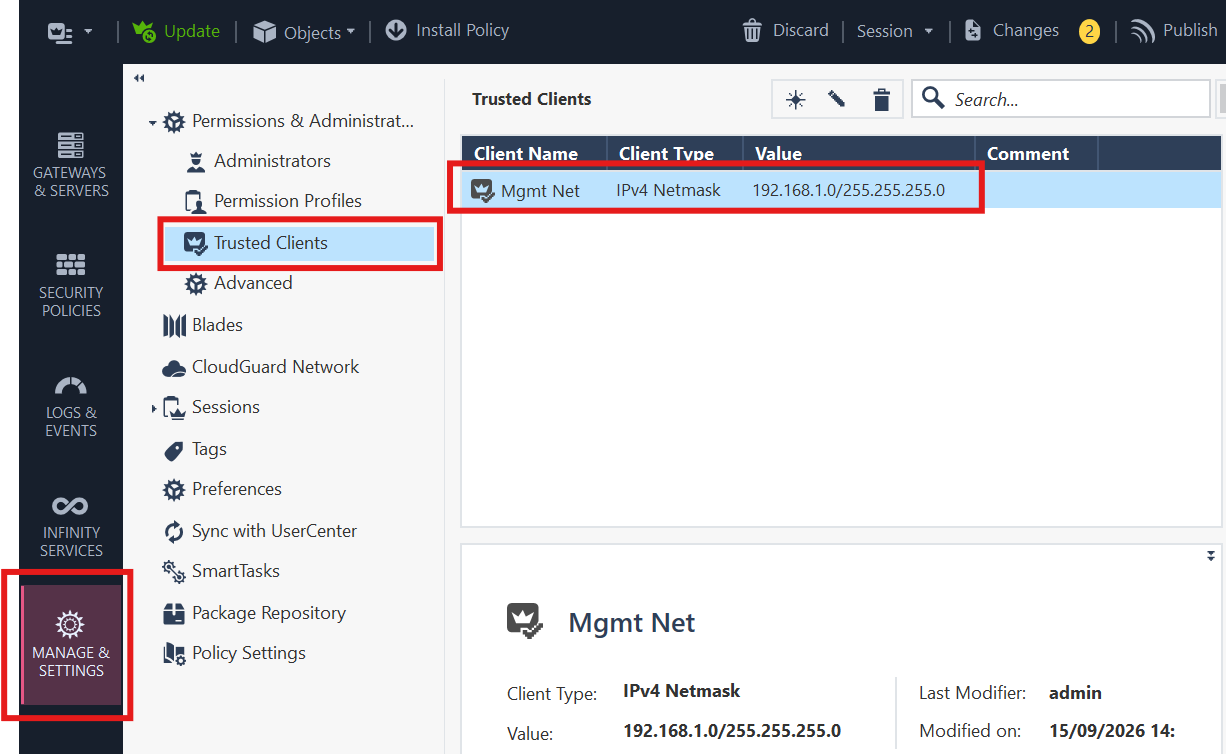
*Editing Trusted Clients rules in SmartConsole (**Check Point Software**)*
### A Pattern of Exploited Vulnerabilities
This latest patch follows a series of warnings from **Check Point** regarding other actively exploited flaws in its products. In recent months and years, several critical vulnerabilities have been leveraged by threat actors:
* **CVE-2024-24919**: Two years ago, **CISA** flagged a flaw in **Check Point's Quantum Security Gateways** as actively exploited by ransomware groups, specifically linked to **NailaoLocker ransomware** by **Orange Cyberdefense CERT**.
* **CVE-2026-50751**: An authentication bypass zero-day was exploited by **Qilin ransomware** affiliates since June.
* **CVE-2026-16232**: A second authentication bypass zero-day has been exploited since at least July, allowing attackers to authenticate with administrator privileges to **SmartConsole** admin panels.
Just two weeks prior, the **Dutch National Cyber Security Centre (NCSC-NL)** issued a warning about two critical **Check Point VPN** flaws (**CVE-2026-85102** and **CVE-2026-85103**), anticipating imminent exploitation. More recently, **Check Point** released security updates for another critical authentication bypass, also **CVE-2026-16232**, affecting the login process for **Security Management Server** and **Security Gateways**, which allows attackers to execute code with root privileges on management systems.
While this specific iteration of **CVE-2026-16232** has not yet been confirmed as actively exploited by the company, **Check Point** advises monitoring for "Administrator failed to log in: Username too long" alerts in Audit and Admin login logs as potential indicators of attack.