Checkmarx Suffers Third Supply Chain Attack: Malicious Jenkins Plugin Deployed
**Checkmarx**, a prominent application security testing firm, has suffered yet another supply chain attack, this time involving a rogue version of its Jenkins AST plugin. The malicious plugin was uploaded to the Jenkins Marketplace, potentially exposing users to credential-stealing malware.


**Checkmarx** issued a warning over the weekend about a compromised version of its Jenkins Application Security Testing (AST) plugin that had been published on the Jenkins Marketplace.
This compromise is attributed to the **TeamPCP** hacker group, known for initiating a series of supply-chain attacks, including the **Shai-Hulud** campaigns on npm and the **Trivy** vulnerability scanner breach, which resulted in the distribution of credential-stealing malware.
Jenkins is a widely used Continuous Integration/Continuous Deployment (CI/CD) automation solution crucial for software building, testing, code scanning, application packaging, and deploying updates to servers.
The **Checkmarx AST plugin** on the Jenkins Marketplace is designed to integrate security scanning into automated pipelines.
"We are aware that a modified version of the Checkmarx Jenkins AST plugin was published to the Jenkins Marketplace. We are in the process of publishing a new version of this plug-in," Checkmarx stated in an update.
This incident marks the third supply-chain attack **Checkmarx** has faced since late March.
According to an offensive security engineer, **TeamPCP** gained unauthorized access to Checkmarx's GitHub repositories and backdoored the Jenkins AST plugin to deliver credential-stealing malware.
A company spokesperson confirmed that the threat actor obtained credentials to the repositories from the **Trivy** supply-chain attack in March.
The hackers left a message stating: "Checkmarx fails to rotate secrets again. With love - TeamPCP."
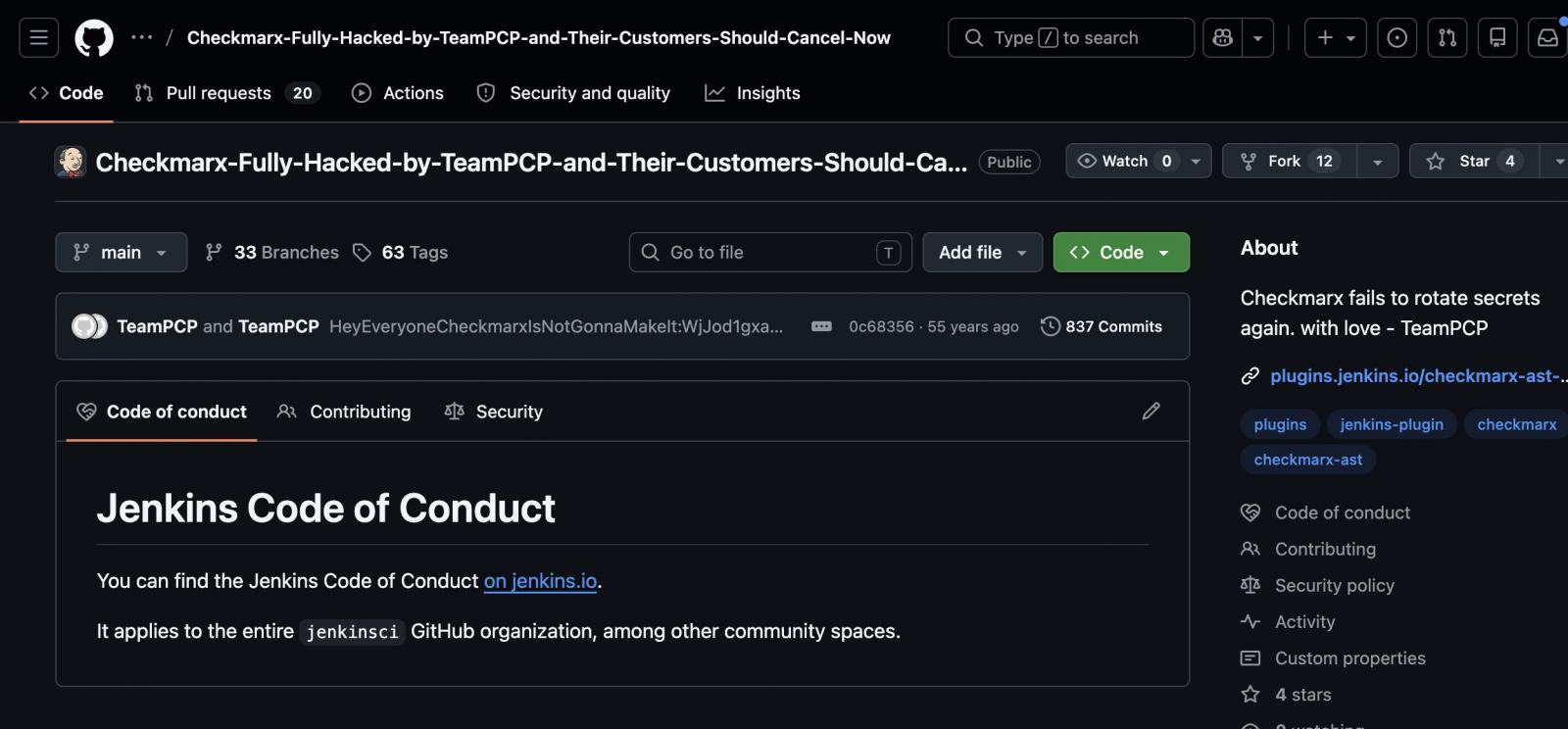
"As a result of that access, the attackers were able to interact with Checkmarx’s GitHub environment and subsequently publish malicious code to certain artifacts," the company spokesperson explained.
Using credentials stolen in the **Trivy** attack, the hackers published modified versions of multiple developer tools on GitHub, Docker, and VSCode that included info-stealing code.
The threat actor maintained access for at least a month before publishing a malicious version of the company's **KICS analysis tool** on Docker, Open VSX, and VSCode, which harvested data from developer environments.
In late April, the company confirmed that the **LAPSUS$** threat group leaked data stolen from its private GitHub repository.
On Saturday, May 9, a rogue version (2026.5.09 ) of the Checkmarx Jenkins AST plugin was uploaded to repo.jenkins-ci.org. This update, outside the plugin's release pipeline, contained malicious code.
Notably, the malicious plugin deviated from the official date style scheme and lacked a git tag and a GitHub release.
Checkmarx is advising users to ensure they are using version 2.0.13-829.vc72453fa_1c16 of the plugin, published on December 17, 2025, or an older version.
While Checkmarx has not disclosed specific details about the malicious plugin's actions, users who downloaded the rogue version should assume their credentials have been compromised. They are advised to rotate all secrets and investigate for lateral movement or persistence.
Checkmarx asserts that its GitHub repositories are isolated from its customer production environment, and no customer data is stored in the GitHub repository.
"We have communicated with our customers throughout this process and will continue to provide relevant updates as more information becomes available," the cybersecurity company stated, directing customers to the Support Portal or the Security Updates sections for recommendations.
Checkmarx has published a set of malicious artifacts that defenders can use as indicators of compromise (IoCs) within their environments.
[99% of What Mythos Found Is Still Unpatched.](https://hubs.li/Q04crVgD0)
AI chained four zero-days into one exploit that bypassed both renderer and OS sandboxes. A wave of new exploits is coming.
At the Autonomous Validation Summit (May 12 & 14), see how autonomous, context-rich validation finds what's exploitable, proves controls hold, and closes the remediation loop.
[Claim Your Spot](https://hubs.li/Q04crVgD0)