China-Linked Hackers Exploit REDCap Servers, Steal Medical Research with 'InfiniteRed' Malware
A sophisticated China-linked espionage campaign, attributed to **UNC6508**, has been uncovered targeting **REDCap** servers within a North American medical institution. The attackers deployed custom malware dubbed **InfiniteRed** to exfiltrate sensitive medical and scientific research data, remaining undetected in the victim's network for over a year.

A new report from **Google Threat Intelligence Group (GTIG)** details a long-running espionage campaign by a China-linked threat actor, **UNC6508**. The group successfully breached **REDCap** servers at a North American medical research institution, stealing sensitive data for over a year.
**REDCap** is a widely adopted platform for building and managing databases and surveys in medical and scientific research, adhering to relevant regulatory standards.
### Initial Compromise and Persistence
While the precise initial access vector remains unconfirmed, researchers observed **UNC6508** probing older, vulnerable versions of **REDCap**. The compromise of the medical research organization occurred in September 2023, with malicious activity continuing through November 2025.
Three months after initial access, the attackers deployed **InfiniteRed**, a custom malware specifically designed for **REDCap** systems. This malware's components were hidden by trojanizing the server’s system files.
### The InfiniteRed Malware Suite
**InfiniteRed** comprises three main components:
* A persistence/update module
* A credential harvester
* A backdoor
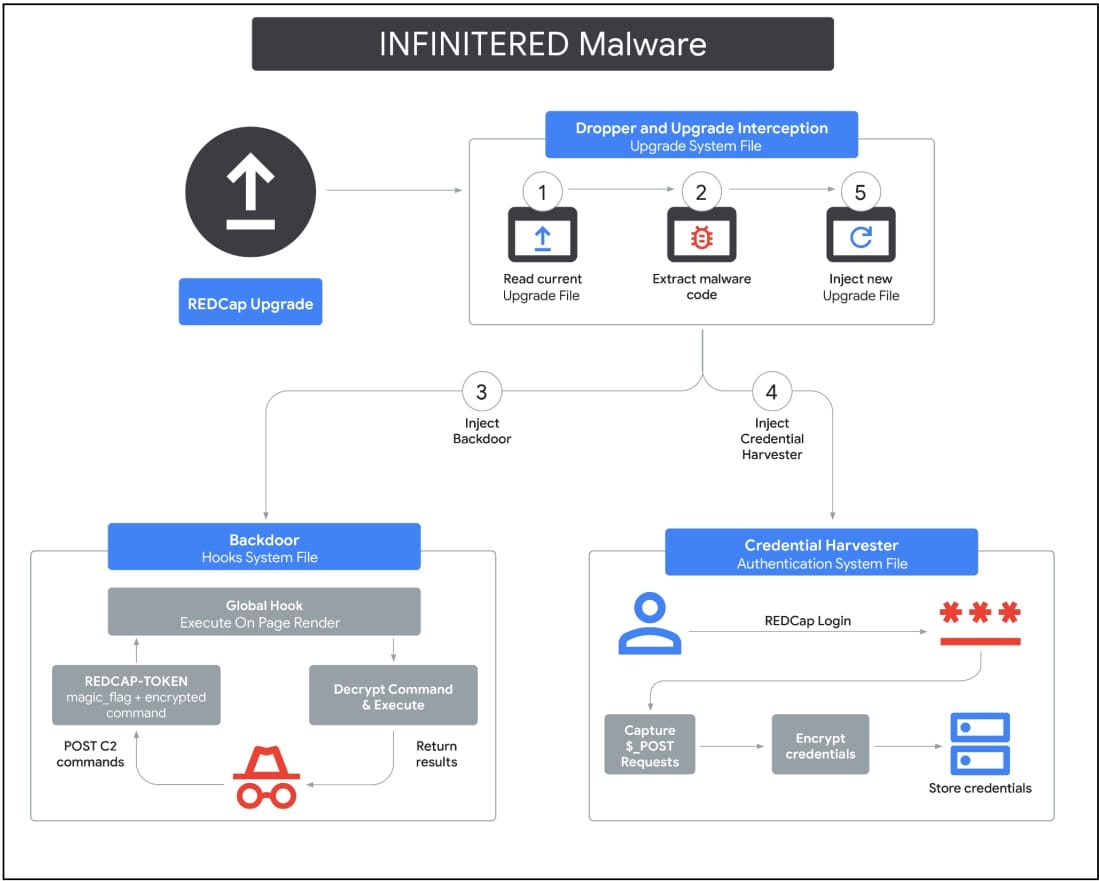
The credential harvester actively captures usernames and passwords submitted through **REDCap** login pages. These stolen credentials are then encrypted and stored in local **REDCap** database tables for later retrieval.
The backdoor, which receives commands via HTTP cookies, grants **UNC6508** extensive control over the compromised server, including the ability to:
* Execute shell commands
* Upload and download files
* Run arbitrary SQL queries
* Retrieve and delete stolen credential records
* Access system and database information
### Novel Data Exfiltration Techniques
In a notable departure from typical China-linked threat actor tactics, **UNC6508** utilized legitimate 'content compliance rules' within cloud-based enterprise productivity tools for data exfiltration. After gaining administrator access, the group created a rule named “Patriot.”
This rule was configured to scan the organization's communications for specific keywords, content patterns, email addresses, and phone numbers. Any matches were then automatically forwarded as a blind carbon copy (BCC) to '[email protected]', an address since disabled by **Google**.
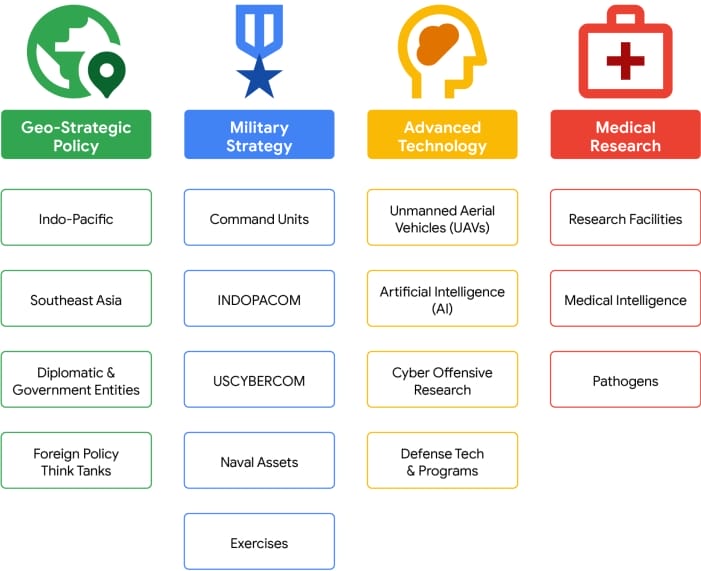
The keywords used for exfiltration were highly targeted, focusing on medical research, advanced technology, military topics, and geo-strategic policy, indicating a clear intelligence-gathering objective.
### Operational Security and Impact
**GTIG** observed a high level of operational security throughout the campaign, including the use of US-based residential proxy infrastructure, compromised routers, VPS, credential replay, and dedicated infrastructure for data exfiltration.
**Google** has notified multiple organizations in the U.S. and Canada that were found to be compromised with the **InfiniteRed** malware. These organizations span critical research areas, from molecular discovery and clinical drug trials to state-level public health policy and military readiness.
### Recommendations for Defense
To mitigate similar threats, **REDCap** administrators are strongly advised to:
* Upgrade their instances to the latest available versions and remove any legacy deployments.
* Implement Multi-Factor Authentication (MFA) or 2-Step Verification (2SV) on all high-privilege accounts.
* Consider using Device Bound Session Credentials (DBSC) to prevent session hijacking.
**GTIG**'s report includes **YARA** rules and Indicators of Compromise (IoCs) to assist security teams in scanning their environments for **InfiniteRed** malware infections.