Cisco Unified CM Vulnerability Under Active Exploitation, Root Privileges at Risk
A high-severity Server-Side Request Forgery (SSRF) vulnerability, **CVE-2026-20230**, in **Cisco Unified Communications Manager (Unified CM)** and **Cisco Unified Communications Manager Session Management Edition (Unified CM SME)** is now being actively exploited. This flaw could allow unauthenticated attackers to gain root privileges by writing arbitrary files to the underlying operating system.


**Cisco** initially released security updates for **CVE-2026-20230** on June 3, warning of the potential for attackers to achieve root access. The vulnerability stems from improper input validation for specific HTTP requests within the **Unified CM** and **Unified CM SME** platforms.
### The Path to Root Privileges
According to **Cisco's** advisory, a successful exploit could allow an attacker to write files to the operating system, which could then be used to elevate privileges to `root`. The flaw was responsibly disclosed to **Cisco** by **SSD Secure**.
### Active Exploitation Confirmed
Threat intelligence firm **Defused** recently confirmed active exploitation of this vulnerability. They observed attacks originating from a single IP address, utilizing properly constructed `file://` payloads to create files on targeted devices.
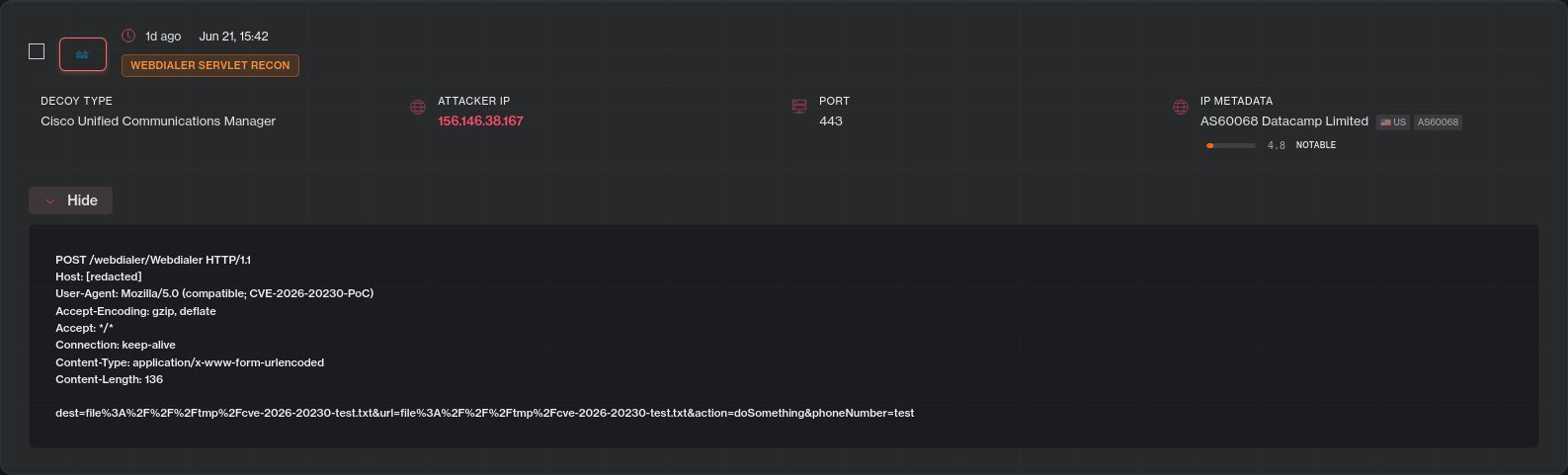
*Source: Defused*
While the initial exploits observed by **Defused** appear to be reconnaissance-oriented – attempting to write a text file named `/tmp/cve-2026-20230-test.txt` – the potential for more malicious attacks is significant.
### Technical Details Emerge
Following the disclosure of active exploitation, **SSD Secure** published a detailed technical write-up and proof-of-concept (PoC) exploit. Their research demonstrated how an unauthenticated attacker could abuse the **Webdialer** component's handling of user-supplied URLs to write arbitrary files to the operating system using `file://` URIs.
By manipulating the file path and content, an attacker could achieve remote code execution (RCE) and ultimately gain root privileges. **SSD Secure** also noted that attackers would first need to obtain the target system's hostname, a detail they showed could be retrieved from the device prior to exploitation.
### Urgent Action Required
Given the full disclosure of the vulnerability and the existence of a public PoC, it is highly probable that more threat actors will begin targeting these servers. IT security professionals and privacy-conscious users managing **Cisco Unified CM** deployments are urged to apply the latest security updates immediately to mitigate the risk of compromise. Organizations should also monitor their systems for any indicators of compromise related to **CVE-2026-20230**.