DDoS-as-a-Service: Underground Marketplaces See Surge in Sophisticated Offerings
Distributed Denial-of-Service (DDoS) attacks remain a potent threat, and a new report from **Flare** reveals a concerning trend: the increasing sophistication and commercialization of DDoS-as-a-Service (DaaS) offerings in underground marketplaces. What was once a scattered landscape of scripts and tools has evolved into a polished, readily accessible service, lowering the barrier to entry for malicious actors.


You've likely experienced it: a website suddenly unresponsive, a login page timing out, or an online service becoming unreachable. While internal outages can be the culprit, often it's a Distributed Denial-of-Service (DDoS) attack designed to overwhelm the service from the outside.
DDoS attacks disrupt online services by flooding them with traffic, exhausting infrastructure, and rendering them unreachable without breaching systems. Now, DDoS is being packaged, branded, and sold as a mature online service, with significant real-world impact.
**Cloudflare** reported blocking a 7.3 Tbps attack in 2025 and later mitigated a 31.4 Tbps attack in its Q4 2025 DDoS report. **Microsoft** also reported that **Azure** mitigated a 15.72 Tbps attack in October 2025, attributing it to the **Aisuru** botnet.
Behind these incidents, underground sellers compete for buyers with increasingly polished pitches. Recent analysis by **Flare** researchers highlights attack panels, API access, monthly plans, reseller options, customer support, botnet-backed capacity, game-server methods, and **Cloudflare** bypass claims.
A comparison of DDoS-related underground activity from the first five months of 2023 and 2026 reveals the rapid evolution of these offerings. What once appeared as scripts, tutorials, leaked tools, and scattered forum posts is now a repeatable product, easier to buy and operate.
## What is DDoS?
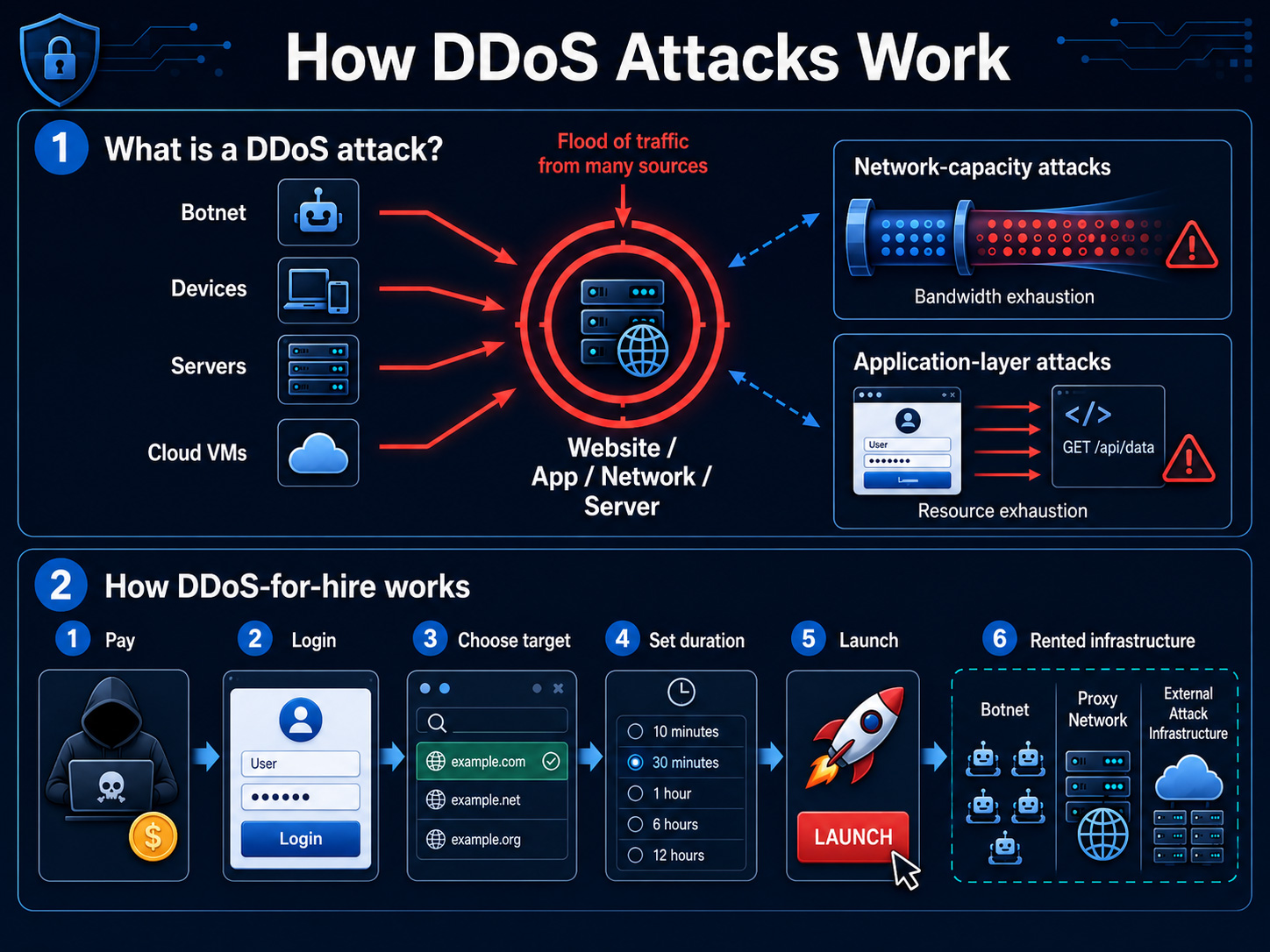
A DDoS attack overwhelms a target (website, application, network, or server) with traffic from numerous sources. Attacks can target network capacity or application layer resources like login pages and APIs. The primary goal is to make the service unavailable, unstable, or expensive to maintain.
DDoS-as-a-service further reduces the barrier to entry. Attackers can pay for access to a web panel, choose a target and duration, and leverage someone else's botnet or proxy network.
## Flare Researchers Analysis
**Flare** researchers analyzed DDoS-related underground activity from the first five months of 2023 and 2026. The curated data revealed significant trends:
| Topic | 2023 | 2026 | Change |
|-----------------------------|-------|-------|---------------|
| Volume of records | 4,403 | 4,964 | Slight increase |
| High-signal DDoS service ads | 38 | 364 | ~10x increase |
| Unique ad clusters | 31 | 123 | ~4x increase |
| Unique actors | 15 | 41 | ~3x increase |
| Sources observed | 22 | 43 | ~2x increase |
*Note: This research focused on distributed DoS (DDoS), excluding single-source denial-of-service (DoS) offerings.*
## From Scattered Tools to Packaged Services
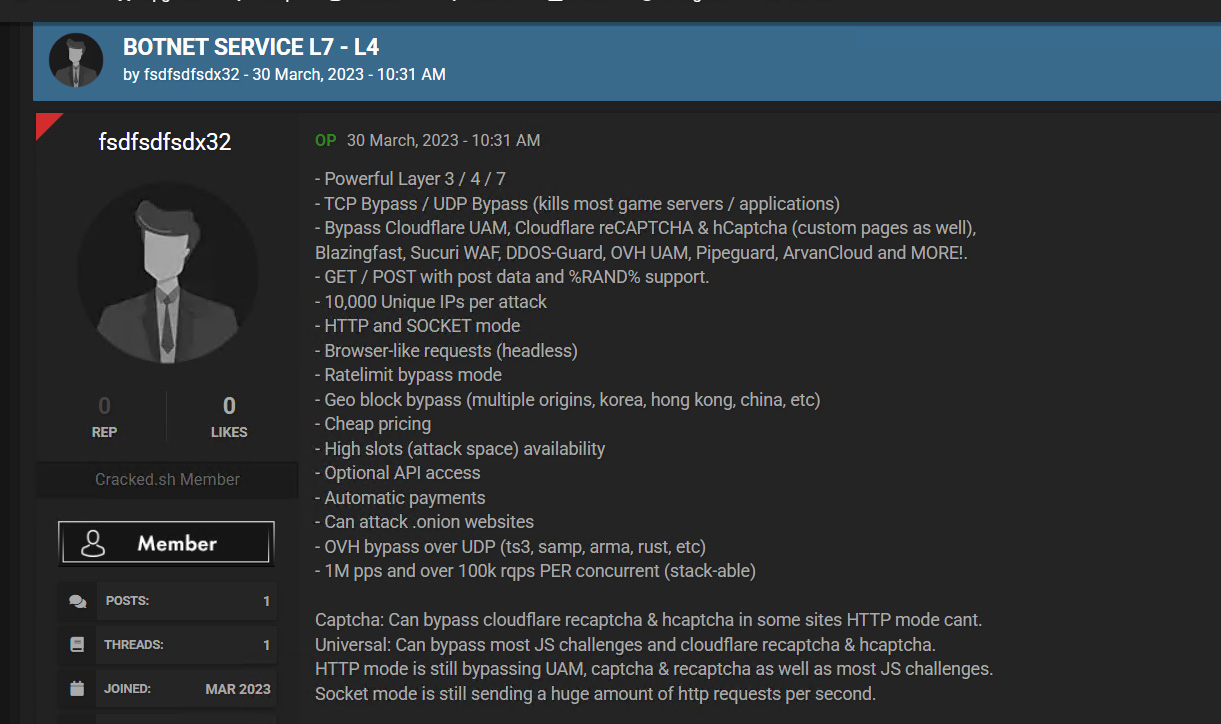
Posts from 2023 were more diverse, revolving around scripts, leaked tools, tutorials, or generic "botnet service" advertisements.
One recurring post from 2023 promoted a "Botnet Service L7 - L4," claiming Layer 3, Layer 4, and Layer 7 capabilities, optional API access, automatic payments, high attack slots, game-server targeting, and **Cloudflare** bypasses. The same text appeared across multiple sources, suggesting reselling or recycled marketing.
More recent posts from 2026 emphasize price and offerings.
An advertisement for "SatelliteStress" described the service as an IP stresser with a user-friendly panel, API access, game-server support, and monthly plans starting at €20. The post claimed "100% botnet-powered" infrastructure.
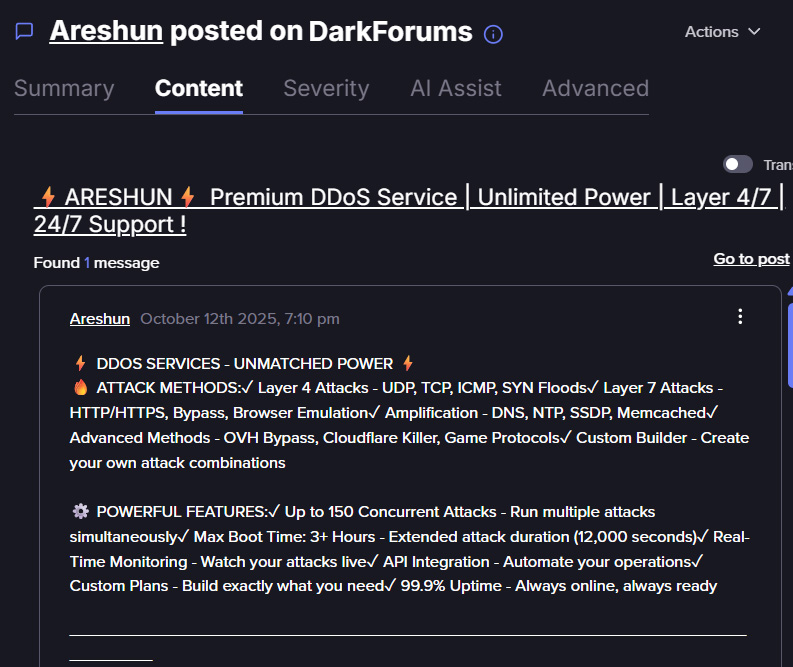
"Areshun" offers a "Premium DDoS Service" with Layer 4 and Layer 7 attacks, monitoring, API integration, custom plans, 24/7 support, and promotional discount codes.
"RebirthStress" is marketed as a botnet-powered IP and web stressing device, a free Layer 7 hub, 400+ slots, reselling suitability, and plans from $15/month.
The trend is clear: 2026 posts focus on a product, with sellers competing for customers by packaging features like ease of use, automation, support, privacy, reselling capacity, and reliability.
## The Technical Language Became Part of the Sales Pitch
Technical details haven't disappeared; they've become part of the sales pitch. Ads in 2026 commonly bundle Layer 4 and Layer 7 claims (network-level and application-layer attack support) with terms like "panel," "API," "slots," "bypass," "monitoring," "uptime," and "support."
One THORCC-related ad claimed 7,000+ active Layer 4 bots and promoted bandwidth analytics and attack-vector statistics. Another post presented "professional stress testing" while claiming **Cloudflare** and **DDoS-Guard** bypasses, high concurrency, and long attack durations.
Sellers may exaggerate capabilities, but the consistency of marketing language provides valuable intelligence.
It shows buyers are encouraged to value web panels, automation, bypass claims, and the ability to launch or resell attacks with minimal effort, beyond raw traffic volume.
## The Business Model
The pricing of DDoS attacks in 2026 is remarkably low.