Federal Court Rejects Bid to Dismiss Lawsuit Against Trump-Era Social Media Surveillance
A federal district court has denied the government's motion to dismiss a lawsuit challenging the **Trump administration's** mass surveillance of non-citizens' online speech. This ruling allows the case, brought by prominent labor unions, to proceed and marks a significant step in defending First Amendment rights against broad government monitoring.
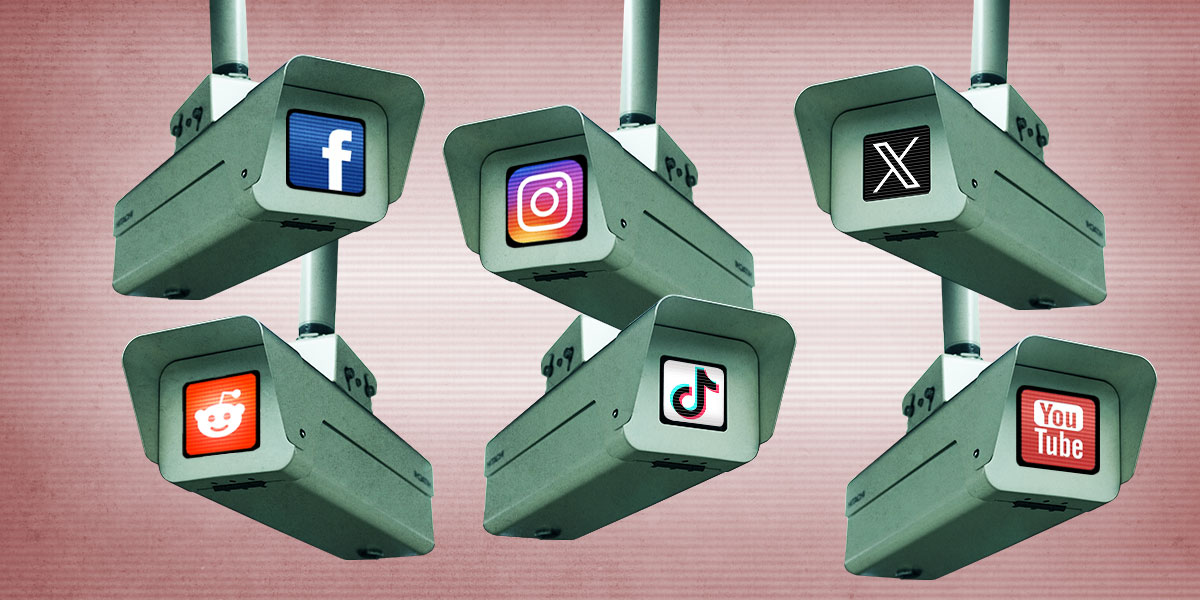
No one should have to choose between speaking freely and protecting their immigration status. Yet that’s precisely the choice the **Trump administration’s** mass surveillance of online speech forces on noncitizens living in the U.S.
Last fall, we sued on behalf of three major labor unions to stop this surveillance program. And just this month, we won our first major ruling: A federal district court denied the government’s motion to dismiss our lawsuit. This means the case can move forward—a win for free speech and a critical step in protecting our First Amendment rights online.
### Our Lawsuit
Since taking power, the **Trump administration** has used AI and other automated tools to broadly surveil the social media and online speech of visa and green card holders, with the goal of identifying and punishing people who express views it opposes. The government is targeting a broad range of views, including criticism of the **Trump administration**; support for Palestine or criticism of Israel; “rationalizing or making light of” **Charlie Kirk’s** murder; and anything nebulously “hostile” to American culture, founding principles, “traditional American views,” or.
It has paired that surveillance with a public intimidation campaign. High-ranking officials have explicitly threatened to punish noncitizens for their online speech, then followed through with a series of terrifying viewpoint-driven enforcement actions. This has led to a significant chilling effect on speech, not just for noncitizens, but also for their families, coworkers, and friends.
In response, three major labor unions—the **United Auto Workers (UAW)**, the **Communications Workers of America (CWA)**, and the **American Federation of Teachers (AFT)**—sued the **Departments of State** and **Homeland Security** alleging that this viewpoint-based surveillance program violates the First Amendment and the **Administrative Procedure Act (APA)**. The unions are represented by **EFF**, **Muslim Advocates (MA)**, and the **Media Freedom & Information Access Clinic (MFIA)**.
The government moved to dismiss our lawsuit, arguing first that federal immigration law prevents federal district courts from hearing the case, and second, that the unions don’t have “standing” to sue. Judge **Alvin K. Hellerstein** of the **Southern District of New York** rejected both arguments and allowed the case to proceed. At this stage in the litigation, the court accepted all of the facts in our complaint as true and analyzed the law based on those facts. We will now prove these facts as the case proceeds.
### Federal Immigration Law Doesn’t Block Our Lawsuit
The government first argued that the court had no power to hear our case at all. It pointed to three provisions of the **Immigration and Nationality Act (INA)** that restrict when federal courts can review immigration matters. The district court disagreed and rejected each provision in turn.
The first provision, **8 U.S.C. § 1252(b)(9)**, is often called the “zipper clause.” It bars federal courts from hearing challenges that arise from efforts to deport someone, except through review of an individual’s final removal order. The government claimed the zipper clause applies here because our lawsuit is really an effort to stop it from initiating adverse immigration actions.
The district court wholly rejected this argument. Relying on the **Second Circuit’s** decision in ***Ozturk v. Hyde***, it held that the zipper clause bars only challenges to a particular individual’s removal proceedings, not a lawsuit like ours that challenges the constitutionality of the surveillance program itself. That the surveillance program might affect someone’s immigration proceeding down the line doesn’t turn our lawsuit into a removal challenge.
The court similarly rejected the government’s argument that **§ 1252(g)** and **§ 1252(f)(1)** prevent federal courts from hearing this case. Our suit, the court explained, “challenges the constitutionality of a government policy that is collateral to any active removal proceedings,” so **§ 1252(g)** doesn’t apply. And **§ 1252(f)(1)** only limits what kind of relief a court can give. So while the court may not be able to stop a particular person’s removal proceedings, it can still block “an unlawful surveillance program that suppresses free speech.”
### The Unions Have Standing to Sue
To sue in federal court, a plaintiff must show that it has “standing” to bring its claims. This requires a plaintiff to show an “injury in fact” that is, among other things, “concrete.” That’s often a high bar in surveillance cases, where plaintiffs can’t easily see what the government is doing behind the scenes. And the **Supreme Court** has held that a person’s mere subjective fear of surveillance is too speculative to confer standing.
Even so, our plaintiffs cleared the bar. The court held that the unions alleged concrete injuries, including a chill on members’ speech that is objectively reasonable, not just subjectively felt. It found that the unions had established standing in two ways: “organizational standing,” based on the unions’ own injuries, and “associational standing,” based on injuries the unions’ members have suffered.
#### Organizational Standing
The court first held that our plaintiffs had successfully alleged an injury to the unions themselves (injury was the only aspect of organizational standing the government disputed). The surveillance program has harmed the unions’ ability to carry out their core responsibilities, including “organizing their members and advocating for the unions’ goals.” The court made two key points:
##### 1. Unions Are Injured When Members Go Silent
As we explained in our complaint, the surveillance program has caused members to step back from union leadership roles; stop participating in union activities online and in person; remove their names from union webpages; and avoid filling out bargaining surveys. Members who might otherwise spread the unions’ message and raise awareness of union issues are staying quiet, hampering the unions’ ability to organize. The court said this amounts to a concrete injury for purposes of standing.
##### 2. Surveillance Doesn’t Need to Target Pro-Union Speech