Beyond the Breach: Gen Report Reveals Sophisticated Attacks Leveraging Trusted Workflows
The latest **Gen H1 2026 Threat Report** highlights a concerning trend: attackers are increasingly exploiting legitimate accounts and user trust rather than breaking systems. Two detailed investigations showcase how banking malware and cryptocurrency hijackers manipulate workflows, making detection more challenging for IT security professionals and privacy-conscious users alike.
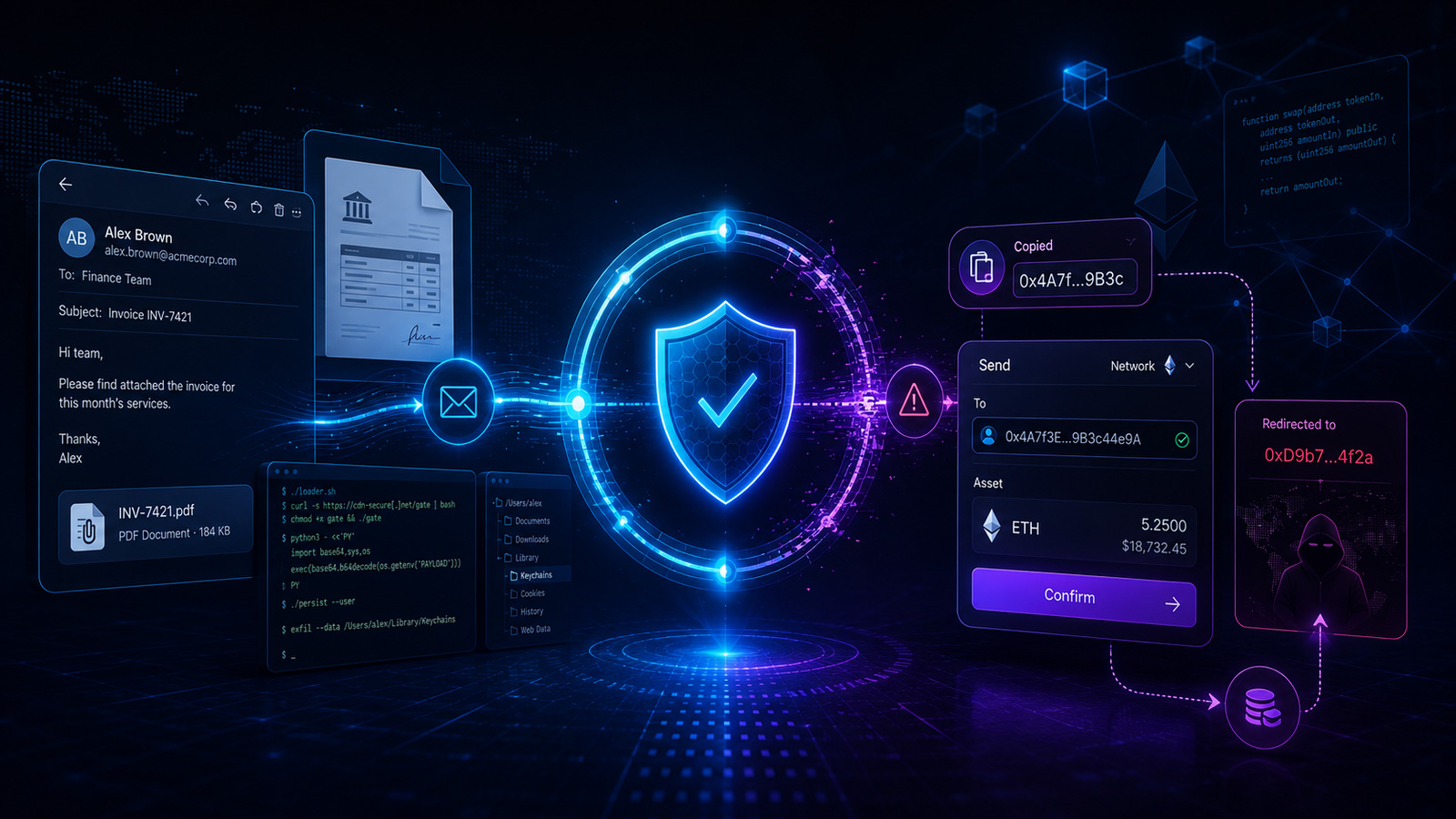

The **Gen H1 2026 Threat Report** provides a comprehensive look at the evolving cyber threat landscape. While scams and malvertising continue to dominate, accounting for nearly 46% and 30% of detections respectively, the report emphasizes the need to understand the intricate attack paths that lead to successful compromises.
Traditional detection metrics often fall short in illustrating the full attack chain, from the initial lure to the final malicious action. **Gen Threat Labs** delves into two distinct campaigns that exemplify this shift towards exploiting trusted systems and user behavior.
### Banking Malware: From Legitimate Email to Session Hijack
One significant campaign targeted users in Czechia, Slovakia, Poland, and Lithuania. Attackers leveraged compromised corporate mailboxes to send seemingly legitimate emails, such as shipment notices or invoice-related messages. This tactic allows the messages to bypass standard email security checks like **SPF** and **DKIM**, as they originate from authorized infrastructure with a legitimate sender history.
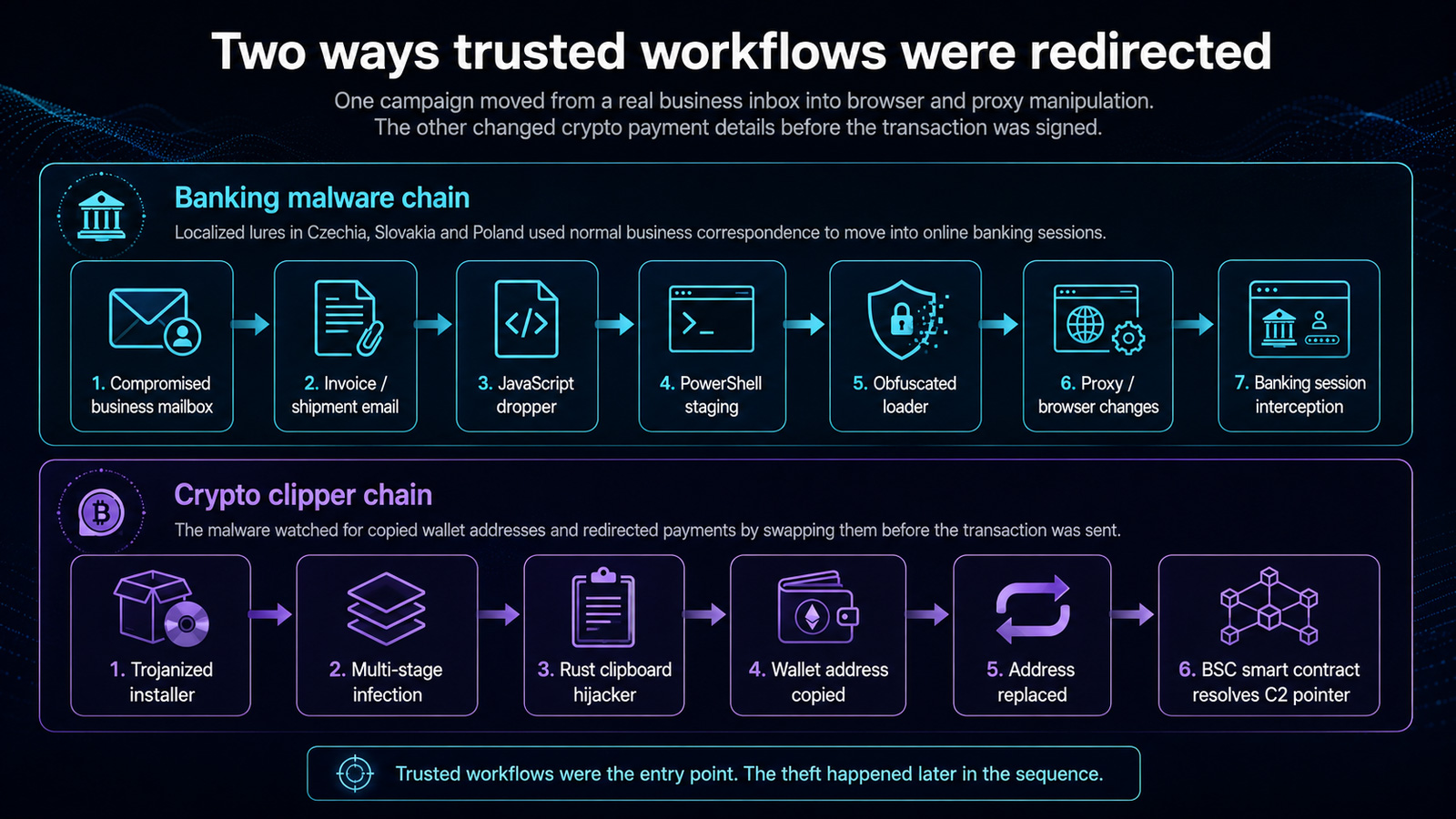
Opening the attachment launched a JavaScript dropper, initiating a multi-stage attack that progressed through PowerShell and eventually delivered shellcode with banking functionality. Indicators pointed towards the **GepyS** malware family.
The malware's ultimate goal was to manipulate proxy settings and install a browser add-on, positioning itself to intercept the victim's banking session. This sophisticated approach highlights how attackers are moving beyond initial access to directly interfere with sensitive user interactions.
Analysis of the payloads revealed techniques designed to slow down static analysis, including MMX and SSE junk instructions, jumps into the middle of instructions, and a decryption routine based on an **LFSR**-generated keystream followed by XOR.
Comparable campaigns observed in H1 2026 include fake invoice PDFs leading to **XWorm** in Italy and steganographic .NET loaders delivering **Remcos RAT** in Poland, all following similar regional and operational patterns.
### Cryptocurrency Clipper: Hijacking the Clipboard with Blockchain C2
The second campaign demonstrates an equally insidious method of attack, targeting the simple act of copying and pasting cryptocurrency addresses. The final payload was a Rust-compiled clipboard hijacker designed to monitor for 21 different blockchain types, including **BTC**, **ETH**, and **LTC**.
Upon detecting a valid wallet address in the clipboard, the malware silently replaced it with an attacker-controlled address. From the victim's perspective, the transaction process appears normal, but the funds are redirected to the attacker's wallet before the transaction is signed.
This attack exploits the human difficulty in verifying long, complex wallet addresses, with many users only checking the first and last few characters. The attackers further enhanced their operational security by using **Binance Smart Chain** as part of their Command and Control (C2) resolution via **EtherHiding**. Instead of storing the full backend on-chain, the malware retrieved infrastructure pointers from data embedded in a smart contract, making network Indicator of Compromise (**IoC**) lists quickly outdated and takedowns more challenging.
### Evolving Detection Strategies
For banking-related threats, **Gen Threat Labs** recommends correlating sender authentication with post-delivery telemetry. Organizations should view JavaScript execution, PowerShell stages, shellcode, and subsequent proxy or browser changes as a single, suspicious sequence, even if the initial email originated from a legitimate, albeit compromised, account.
Mitigation strategies include restricting script interpreters for non-essential users, applying application-control policies to downloaded attachments, and alerting on unexpected proxy or browser-extension modifications. Continuous monitoring for mailbox takeover remains critical.
Regarding cryptocurrency threats, defenders should monitor for clipboard-modifying processes, wallet-address pattern matching, and unusual blockchain queries from applications. The smart-contract pointer and its resolved infrastructure should be tracked together to form a complete indicator set.
Users making cryptocurrency payments are urged to verify the *full* destination address shown by their signing device or wallet immediately before approval. Utilizing address books or allowlists can reduce manual entry errors, and any new or changed destination should prompt a thorough comparison beyond just the initial and final characters.
Both campaigns underscore a critical takeaway: the initial trust decision can be deceptive when the surrounding workflow has already been compromised. Effective detection and verification must encompass all steps between the authenticated email or copied value and the final action.
### Read the full report here: [Gen H1 2026 Threat Report](https://www.gendigital.com/blog/insights/reports/threat-report-h1-2026?utm_source=bleepingcomputer&utm_medium=sponsored_article&utm_campaign=h1_2026_threat_report).