Google to Leverage IP Addresses for Ad Personalization in EEA, UK, and Switzerland Amidst Regulatory Scrutiny
In a significant shift, **Google** has announced it will begin using IP addresses for ad measurement and personalization within the European Economic Area (**EEA**), the **UK**, and **Switzerland** starting August 3, 2026. This move, communicated to advertisers, marks a departure from previous practices in these regions where IP addresses are considered personal data under stringent privacy regulations like **GDPR**.


**Google** has initiated notifications to advertisers regarding its intention to utilize IP addresses for ad measurement and personalization across the **EEA**, the **UK**, and **Switzerland**. This change is slated to take effect on or shortly after August 3, 2026.
While the use of IP addresses for online services is routine globally, their classification as regulated personal data in the **UK** and **EU** introduces new complexities.
## What's Changing
**Google** already processes IP addresses for traffic routing and ad delivery via customer tags, **SDKs**, **HTTP** calls, and uploads. The pivotal change on August 3, 2026, is the *purpose* of this data collection: IP addresses will now be explicitly used to identify devices for measurement and ad personalization.
This new purpose triggers consent requirements under **UK** and **EU** law. **Google** will also register under the **IAB Europe Transparency and Consent Framework** (**TCF**) for Feature 3, described as "Identify devices based on information transmitted automatically." This feature is designed to distinguish devices using automatically transmitted data, including IP addresses, and is linked to personalization purposes that necessitate explicit user consent.
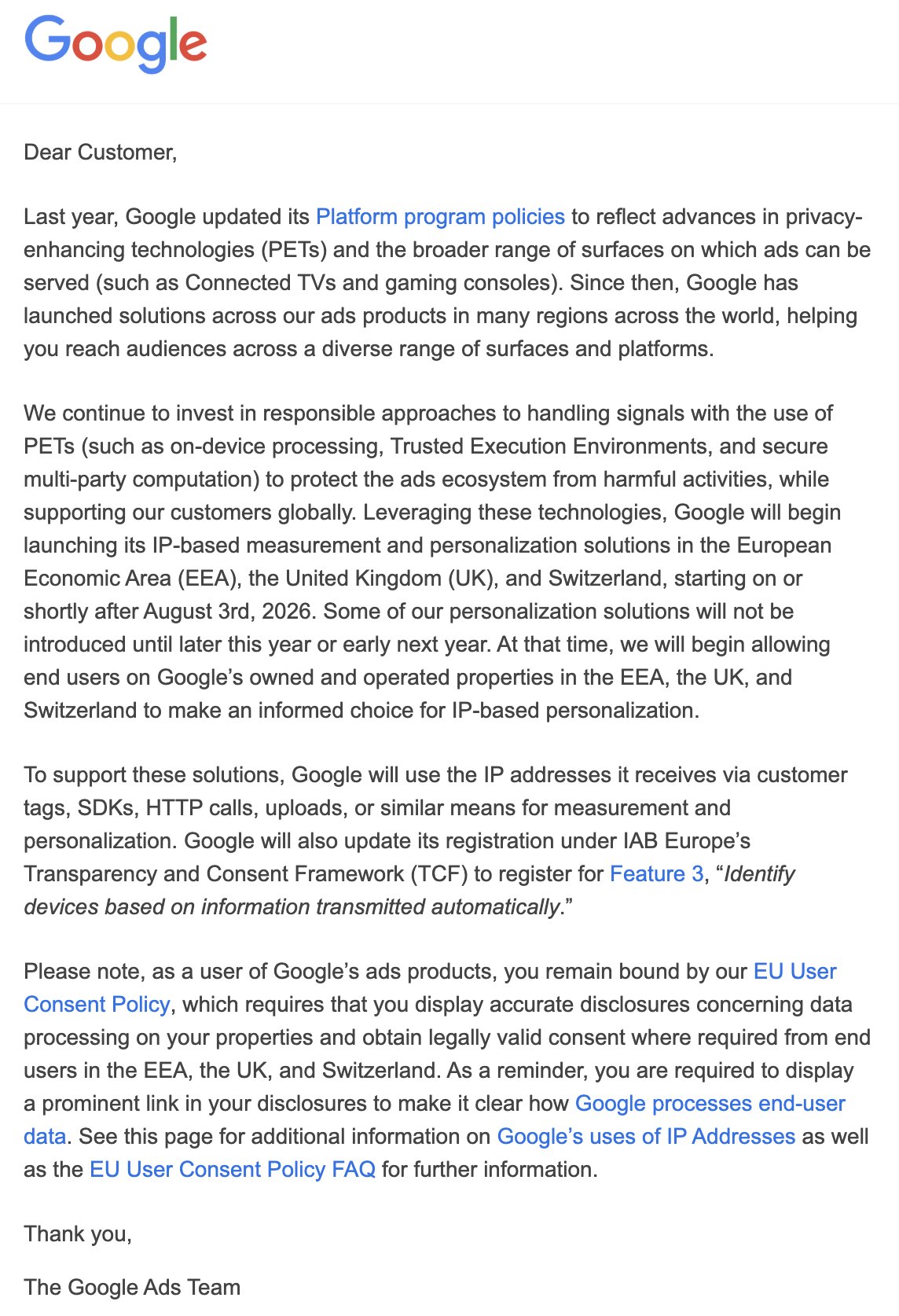
**Google's** email notification sent June 17, 2026 to advertisers (BleepingComputer)
The company frames this initiative around privacy-enhancing technologies (**PETs**), citing on-device processing, trusted execution environments, and secure multi-party computation. Some personalization features will roll out later this year or early next, at which point **Google** states it will provide users on its own platforms with choices regarding IP-based personalization.
## Why It Matters
**Google** has long utilized IP signals for advertising in other parts of the world to combat spam and fraud, maintaining that this is a common practice across the ad ecosystem. However, the **EEA**, the **UK**, and **Switzerland** present a distinct challenge, as an IP address is considered personal data under **GDPR**. Using it to identify a device is a fundamental component of fingerprinting – a method of tracking devices when cookies are blocked or cleared.
Interestingly, **Google** itself once held a different view. In 2019, then-**Chrome** engineering director **Justin Schuh** stated that fingerprinting undermines user choice and is problematic because users cannot clear it like cookies. Yet, in December 2024, **Google** reversed this stance, lifting its prohibition on fingerprinting for advertisers.
The **UK's Information Commissioner's Office** (**ICO**) promptly labeled this reversal as "irresponsible." The timing of **Google's** current announcement is particularly salient, coming shortly after the **ICO** published advice to the **UK** government on May 18, 2026, regarding potential changes to online advertising consent rules.
The **ICO's** preferred approach would permit some advertising without consent only when it is context-based, not reliant on a person's activity over time. It would maintain mandatory consent for tracking that profiles individuals across services. IP-based personalization across various surfaces clearly falls into the category requiring consent.
The **ICO** has emphasized that existing rules remain in effect. **Google's** communication to advertisers shifts the compliance burden, reminding them of their obligations under its **EU User Consent Policy** to obtain valid user consent in the affected regions.
## What Users Can Do
User-facing controls for IP-based personalization are not expected until later in **Google's** rollout. Until then, users can rely on familiar controls: declining non-essential cookies and consent prompts, and reviewing ad personalization settings within their **Google** account at [myadcenter.google.com](https://myadcenter.google.com/).
The crucial question remains whether **Google's** implementation will align with the **ICO's** May advice, particularly concerning cross-service profiling that mandates user consent.