Invisible Unicode Characters: The New Frontier for Phishing Attacks Evading Email Filters
Threat actors are leveraging a sophisticated technique known as ASCII smuggling, using invisible Unicode characters to bypass traditional email security filters. This method, previously seen in AI prompt injection, is now being deployed in large-scale phishing campaigns, posing a significant challenge for IT security professionals and privacy-conscious users.

Phishing campaigns are evolving, with attackers now employing the **ASCII smuggling** technique to conceal malicious content within emails. This method utilizes invisible **Unicode** characters, specifically from the Tags block (**U+E0000–U+E007F**), to evade detection by email security filters.
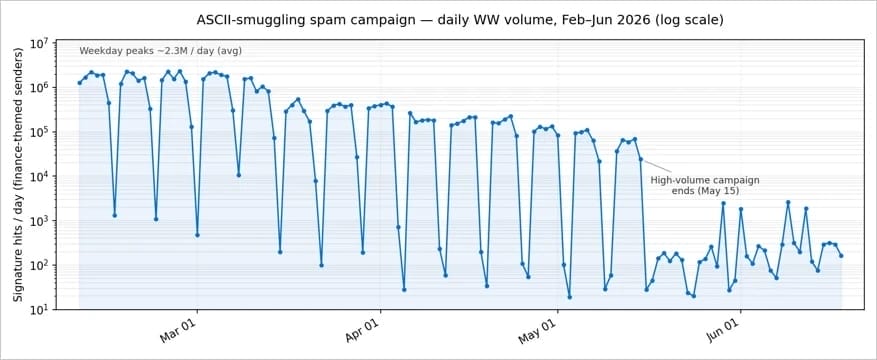
**Microsoft** threat researchers have uncovered a widespread phishing operation that adopted this technique, observing a peak of up to 2.37 million daily messages in late February. While volumes have decreased since May, the campaign remains active.
"The high-volume phase persisted for roughly three months after February 9 and dropped sharply after May 15, 2026," **Microsoft** explained. "These dates bound the observed use of the specific technique in our telemetry, not the broader campaign, which started earlier without it and continued without it."
### How ASCII Smuggling Works in Phishing
In this particular campaign, attackers insert an invisible Unicode character within finance-related keywords, effectively splitting them. For instance, a word like 'funding' might appear as 'fun[invisible character]ding'. This subtle alteration allows the malicious content to bypass filters that rely on keyword lists to identify suspicious or nefarious messages.
.jpg)
**Microsoft** noted that millions of finance-themed phishing messages have utilized this method, and it has proven effective in its intended purpose of evasion. However, **Microsoft Defender** still managed to catch over 99% of these messages by analyzing other signals such as sender reputation, IP addresses, and domain checks.
### Campaign Details and Mitigation
On February 9, **Microsoft** identified a cluster of 148 finance-themed sender domains responsible for approximately 96% of all messages flagged by their new **Defender for Office 365** hunting logic for **Unicode**-tag signatures.
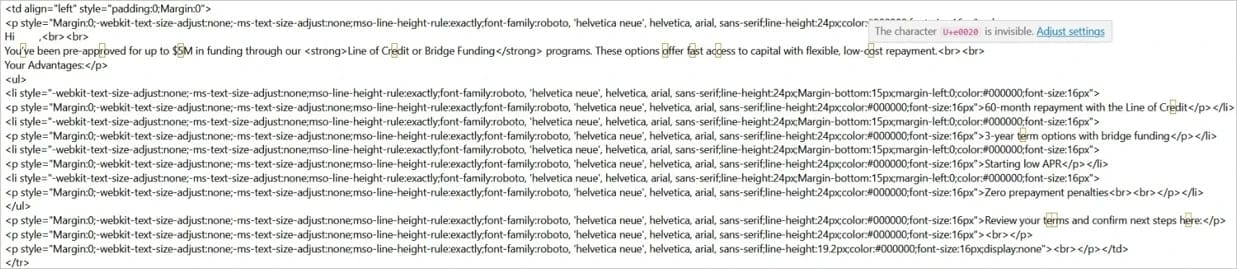
These domains frequently used terms like “funding,” “capital,” “loan,” “advance,” and “credit,” promoting various business funding and credit services. The messages were delivered via infrastructure linked to the legitimate **ActiveCampaign** email-marketing platform.
Upon receiving **Microsoft's** report, **ActiveCampaign** stated that their moderation systems are designed to detect invisible **Unicode** characters similarly to unobfuscated text, flagging heavy usage as suspicious.
To counter this evolving threat, **Microsoft** advises defenders to strip or normalize **Unicode** tag characters and other invisible code points before applying keyword, regex, or signature-based detection. Treating unexpected tag-block characters as a strong anomaly is also recommended. Furthermore, applying the same normalization process before feeding email content to AI assistants can help mitigate the risk of prompt-injection attacks.