Microsoft Offers Temporary Fix for Exchange Web Services (EWS) Apps as Retirement Looms
As **Microsoft** moves forward with the retirement of its **Exchange Web Services (EWS)** API, some **Exchange Online** users are experiencing disruptions with dependent applications. The company has provided IT administrators with temporary methods to re-enable EWS, ensuring business continuity while urging a transition to the **Microsoft Graph API** for long-term solutions.


**Microsoft** has acknowledged that some applications leveraging the **Exchange Web Services (EWS)** API have ceased functioning in **Exchange Online** environments. This disruption comes as the tech giant progresses with the planned deprecation of EWS.
### Understanding EWS and Its Impact
**EWS** is an API crucial for applications that interact with **Exchange** mailbox items, including emails, calendars, and contacts. A wide array of software, from **Outlook** desktop add-ins and older **Outlook for Windows** versions to **Apple Mail/Calendar** on **macOS** and various third-party apps, relies on EWS.
In February, **Microsoft** announced its intention to block the **EWS API** by default starting October 1, 2026, with a final shutdown slated for April 1, 2027. The current issues manifest as errors indicating the protocol is unavailable or repeated authentication prompts.
### Temporary Re-enablement Options
To mitigate immediate disruptions, **Microsoft** is offering IT administrators two primary ways to re-enable EWS:
1. **Microsoft 365 Admin Center**: Administrators can navigate to the Baseline Security Mode page and uncheck "Block your entire organization from using EWS."
2. **Exchange Online PowerShell**: Executing the `Set-OrganizationConfig -EWSEnabled $true` command can re-enable EWS within approximately four hours.
**Microsoft** emphasizes that these are temporary measures. "We are now in the first stage of EWS disablement, where customers are still able to re-enable EWS. Re-enabling EWS will stop working in April 2027," the company stated.
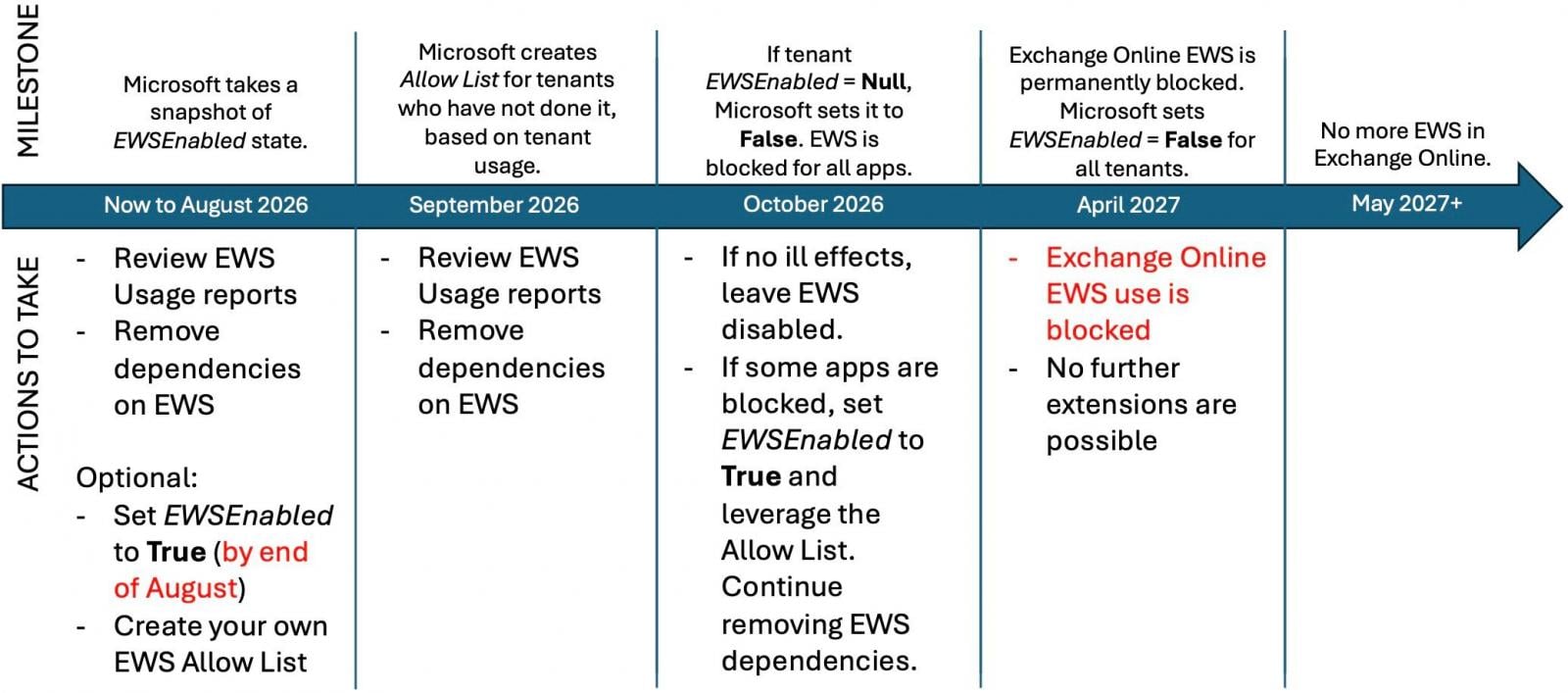
*EWS retirement timeline (Microsoft)*
### The Path Forward: Transition to Microsoft Graph API
For a permanent solution, **Microsoft** strongly advises both developers and users to transition away from EWS. The recommended alternative is the **Microsoft Graph API**, which offers near-complete feature parity with EWS for most scenarios.
"The long-term solution is to update your applications to the application versions that do not use EWS," **Microsoft** advised. "You must contact your application vendor to get the updated application version, or if you created the application yourself, you must change the code to not use EWS anymore."
It's important to note that this retirement process exclusively impacts **Microsoft 365** and **Exchange Online** environments. The **EWS API** will continue to function in on-premises **Exchange Server** installations.
### A Phased Retirement
This current phase of EWS retirement follows a series of prior announcements and actions by **Microsoft**. A warning about EWS ceasing to receive functionality updates was issued in 2018, followed by a more concrete plan for shutdown in September 2023. In October 2021, **Microsoft** had already deprecated and removed support for the 25 least-used EWS **Exchange Online** APIs for security reasons, signaling the long-term strategy to retire the service.