Microsoft Aims to Revitalize Windows 11 with Driver Quality Initiative
**Microsoft** is launching the Driver Quality Initiative (DQI) to address long-standing concerns about driver stability and performance in **Windows 11**. The initiative focuses on improving driver development, verification, and Windows Update catalog hygiene, aiming to deliver a more reliable user experience.

**Microsoft** acknowledges that drivers are crucial to the **Windows** experience, connecting the OS to hardware components and peripherals. To improve the overall quality, **Microsoft** is introducing the Driver Quality Initiative (DQI), a comprehensive plan building upon lessons learned from the **Windows Resiliency Initiative (WRI)**.
### The Driver Quality Initiative (DQI)
The DQI is structured around four key pillars:
* **Shifting to User-Mode Drivers:** Encouraging third-party driver developers to move away from kernel-mode drivers to safer user-mode drivers or **Microsoft**'s own class drivers.
* **Enhanced Partner Verification:** Implementing stricter verification processes for partners, conducting more automated checks, and updating the **Windows Hardware Compatibility Program** requirements.
* **Improved Windows Update Hygiene:** Removing outdated or low-quality drivers from the **Windows Update** catalog and leveraging data to better investigate issues.
* **Holistic Performance Analysis:** Evaluating stability, features, performance, battery impact, and heat generation to enhance the overall **Windows** experience.
**Microsoft** emphasizes that the DQI is a collaborative effort, working closely with partners like **AMD** and **Intel**.
### AMD's Perspective on Driver Quality
**AMD** highlights that driver quality is a shared responsibility. "It’s a shared commitment," says David Harmon, Director, Software Engineering, **AMD**. "Through our close collaboration with **Microsoft**, **AMD** is focused on building a culture of joint accountability to ensure security, stability, and predictable performance for our customers at scale.”
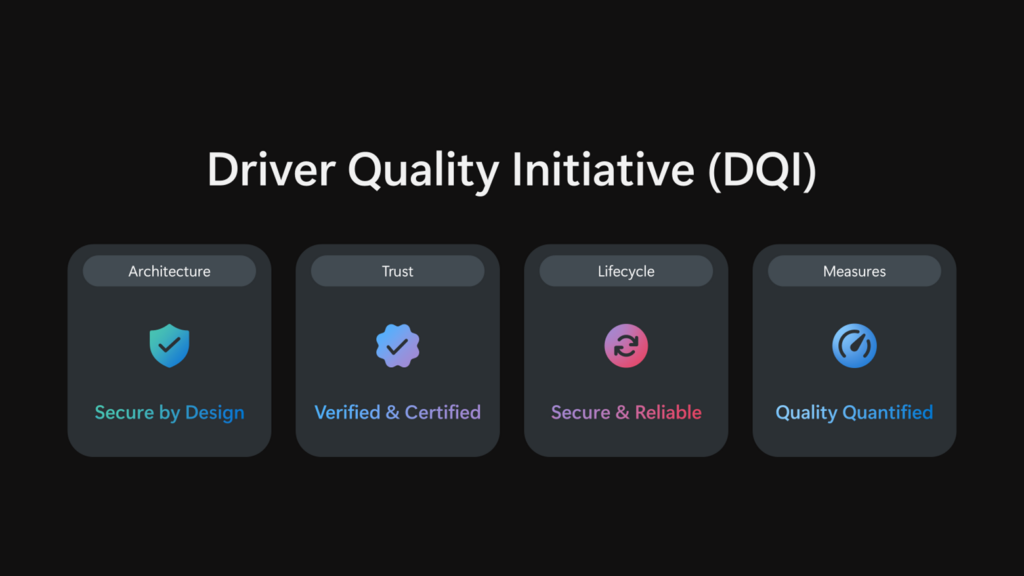
*DQI is based on learnings and infrastructure established through the Windows Resiliency Initiative (WRI)*
The rollout timeline for these changes is not yet clear, but **Microsoft** anticipates that improvements will gradually appear in the coming months as they continue to refine **Windows**.
### Reviving Windows 11
After facing criticism, **Microsoft** is actively working to regain the trust of **Windows** enthusiasts. During the FY26 Q3 earnings call, **Microsoft**'s CEO **Satya Nadella** promised that the company is "doing the foundational work required to win back fans and strengthen engagement across **Windows**, **Xbox**, **Bing**, and **Edge**."
**Microsoft** is also planning other quality-of-life improvements for **Windows 11**, including restoring the movable taskbar and adding a toggle to make the taskbar smaller.
Other rumored features include a native Start menu, faster launch, reduced power consumption, a new performance mode, and more.
<div>
<p><a rel="noopener nofollow" href="https://hubs.li/Q048zztN0"><img alt="article image" src="https://www.bleepstatic.com/c/p/validation-gap.jpg"></a></p>
<div>
<h2><a rel="noopener nofollow" href="https://hubs.li/Q048zztN0">The Validation Gap: Automated Pentesting Answers One Question. You Need Six.</a></h2>
<p>Automated pentesting tools deliver real value, but they were built to answer one question: can an attacker move through the network? They were not built to test whether your controls block threats, your detection rules fire, or your cloud configs hold.</p>
<p>This guide covers the 6 surfaces you actually need to validate.</p>
<p><a rel="noopener nofollow" href="https://hubs.li/Q048zztN0">Download Now</a></p>
</div>
</div>