Microsoft Warns of Surging ACR Stealer Attacks Targeting Enterprise Data
Microsoft has issued a stern warning regarding a significant increase in attacks leveraging the **ACR Stealer** malware. Threat actors are employing sophisticated social engineering and delivery methods to pilfer sensitive data, including passwords, authentication tokens, and documents, from enterprise customers. This surge, observed since late April, highlights the evolving threat landscape facing organizations.

Microsoft's security teams have detected a notable uptick in campaigns deploying **ACR Stealer**, an info-stealing malware-as-a-service (MaaS) believed to be a rebrand of **Amatera Stealer**. These attacks primarily target browser-stored credentials, session data, and critical documents.
### Evolving Attack Chains
Between late April and mid-June, threat actors utilized the **ClickFix** social engineering method, **WebDAV** servers, and the **MSHTA** (Microsoft HTML Application Host) utility to deliver the malicious payloads.
**Microsoft** has identified two primary intrusion chains as the most prevalent for **ACR Stealer**:
#### Campaign 1: WebDAV-Based ClickFix
This method initiates with a **ClickFix** lure that executes a command, running a malicious DLL from a remote **WebDAV** share via `rundll32.exe`. The abuse of **WebDAV** is a familiar tactic, previously seen in attacks delivering **Bumblebee** and **Voldemort** malware.
Threat actors often obscure their activity by using GUID-based directory structures and filenames (e.g., `google.ct`) in the **WebDAV** path, mimicking legitimate resources to blend with expected network traffic.
Upon establishing communication with the command-and-control (C2) infrastructure, a heavily obfuscated PowerShell script is executed. This script launches a malware installer, establishes persistence by creating a scheduled task disguised as a software update, manipulates timestamps, clears PowerShell history, and injects the final payload into a system process for in-memory execution.
Some variants of this campaign also employ public blockchain services as dead-drop resolvers to retrieve updated payload locations or C2 addresses. This technique, also known as “**EtherHiding**,” has been observed in other sophisticated attacks.
#### Campaign 2: MSHTA and Steganography
In the second prominent delivery chain, the threat actor uses **ClickFix** to launch **MSHTA**, which then retrieves malicious content from the attacker's server. This triggers an obfuscated PowerShell downloader.
The malware subsequently extracts an encrypted payload, cunningly concealed within a publicly hosted steganographic JPEG image, and executes it directly in memory.
### Data Exfiltration Objectives
Despite their differences in delivery, both campaigns share the same objective: the comprehensive exfiltration of sensitive data. This includes:
* Stealing passwords, cookies, session data, and authentication tokens from web browsers.
* Decrypting browser data using the Windows Data Protection API (**DPAPI**).
* Accessing **Chromium** browser databases on **Chrome** and **Edge**.
* Searching for PDFs and **Microsoft 365** documents.
* Collecting files from Desktop and Downloads folders.
* Targeting enterprise-synchronized **OneDrive** and **SharePoint** directories.
All harvested data is archived and prepared for exfiltration to the attacker's infrastructure.
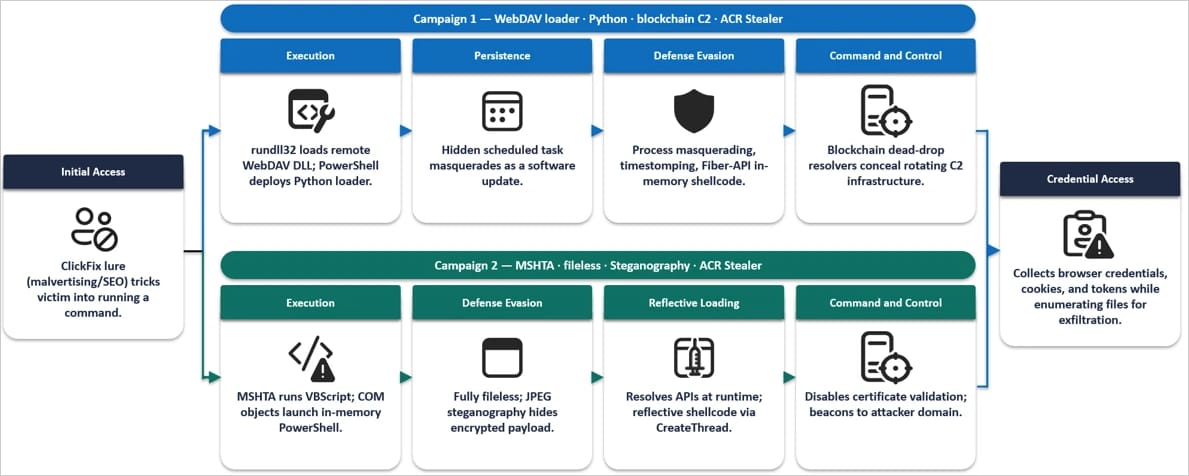
**Microsoft** emphasizes that these two campaigns represent only a fraction of the observed **ACR Stealer** delivery methods, suggesting that additional execution chains are likely in use.
### Mitigating the Threat
To defend against **ClickFix** attacks, users should exercise extreme caution and avoid copying and executing instructions from untrusted sources, particularly those claiming to fix errors or verify humanity.
Organizations are strongly advised to:
* Reduce exposure to web-based delivery chains by enforcing strict content filters, blocking low-reputation or new domains, and restricting access to online resources not essential for business operations.
* Implement application control rules to restrict the launching of content from remote resources using tools like PowerShell, Python, `mshta.exe`, or `rundll32.exe`, especially from user-writeable paths.
**Microsoft**'s comprehensive report provides a detailed list of recommended mitigations and specific indicators of compromise (IoCs) related to the observed **ACR Stealer** activity.