NVD's Vulnerability Backlog: A Growing Chasm in Enterprise Security
The National Vulnerability Database (**NVD**) is struggling to keep pace with the explosion of new vulnerabilities, leading to a significant backlog. This shift in **NVD** operations, including the reclassification of tens of thousands of **CVEs**, forces security teams to re-evaluate their vulnerability management strategies and embrace multi-source intelligence to stay ahead of attackers.


### When Vulnerability Volume Outpaces the System
The cybersecurity landscape is undergoing a dramatic transformation. The **National Institute of Standards and Technology (NIST)** recently announced critical updates to **NVD** operations, a necessary response to an unprecedented surge in **CVE** volume. This move has seen approximately 30,000 vulnerabilities published before March 1, 2026, reclassified as "Not Scheduled."
While prioritization and selective processing are logical adjustments, they introduce new risks for enterprise defenders. **Action1's 2026 Software Vulnerability Ratings Report** highlights this pressure, revealing a 92% increase in disclosed vulnerabilities across enterprise software categories in 2025 compared to 2024. Critical and high-severity vulnerabilities each surged by 103%, with remote code execution vulnerabilities spiking by 128%.
This escalating volume is overwhelming systems designed for a less rapid era of vulnerability discovery. The core issue isn't just a backlog; it's how this backlog is managed and the signals it sends by prioritizing newer vulnerabilities over older, unprocessed ones.
### What Happens When Enrichment Falls Behind
By focusing enrichment efforts solely on recent **CVEs**, the system implicitly deprioritizes vulnerabilities that may already be known, confirmed, and actively discussed by vendors or researchers but lack full **NVD** context.
This creates a dangerous information asymmetry: partial intelligence without the actionable context. Security teams heavily reliant on **NVD** as a normalized source may encounter incomplete or delayed data. Meanwhile, attackers face no such constraints, rapidly correlating vendor advisories, security research, patch releases, exploit information, and public disclosures.
Enrichment is not merely cosmetic. Structured metadata, affected-platform information, severity scoring, and configuration details are crucial for defenders to determine a vulnerability's applicability and urgency. When this information is missing or delayed, organizations are forced to either wait or make decisions with fragmented data—neither is ideal in a threat landscape where exploitation moves at lightning speed.
### The Ripple Effect of Uncertainty
Beyond the immediate backlog, a second-order effect is the uncertainty regarding coverage. A continuously fed, selectively drained backlog creates a semi-permanent state where some vulnerabilities are enriched quickly, others remain in limbo, and visibility into their status is limited.
For practitioners, this complicates prioritization significantly. Incomplete or overly broad **CPE** data can lead to false positives, causing teams to waste time investigating irrelevant vulnerabilities while potentially overlooking genuine risks. Over time, this erodes confidence in the dataset, pushing organizations to build costly, complex, and potentially less reliable alternative intelligence pipelines.
### Vulnerability Management Is Changing
This situation doesn't imply irresponsible action by **NIST**; the scale problem is undeniable. However, the introduced trade-off shifts more responsibility downstream. Organizations must reduce reliance on a single authoritative source and instead correlate data from multiple sources, including **NVD**, vendor advisories, independent vulnerability-intelligence providers, threat intelligence platforms, and internal asset inventories.
Vulnerability management is evolving from consuming a curated list to synthesizing accurate intelligence from incomplete data in near real-time. This demands a level of maturity, tooling, and process discipline that not all organizations currently possess. The **NVD** will remain critical, but it will no longer serve as a comprehensive baseline on its own; it becomes one input among many, potentially lagging significantly behind real-world exploitation.
### How Defenders Should Adapt
The primary lesson is that vulnerability management can no longer depend on a singular source of enrichment. While **NVD** remains valuable, security teams must increasingly integrate cumulative intelligence from vendors and organizations that aggregate available data into usable insights.
Collecting more feeds, however, can simply create another prioritization problem. The true objective is to transform fragmented vulnerability intelligence into decisive action: **Does this vulnerability affect us, how urgent is it, and what can we do about it now?**
This is the model adopted by **Action1** for vulnerability management. Rather than exclusive reliance on **NVD** enrichment, **Action1** combines intelligence from sources like **VulnCheckNVD++**, **NIST NVD**, **CISA’s KEV Catalog**, **Microsoft’s MSRC** data, and vendor release notes. It then scores each vulnerability based on **CVE** data, **CVSS** severity, **CISA KEV** status, and known usage in ransomware campaigns, providing initial prioritization in minutes.
This intelligence is correlated with real-time endpoint data, enabling teams to determine which vulnerabilities truly affect deployed software and prioritize remediation accordingly. Once an affected endpoint is identified, remediation should not involve another export, manual correlation, or lengthy handoff before patching begins.
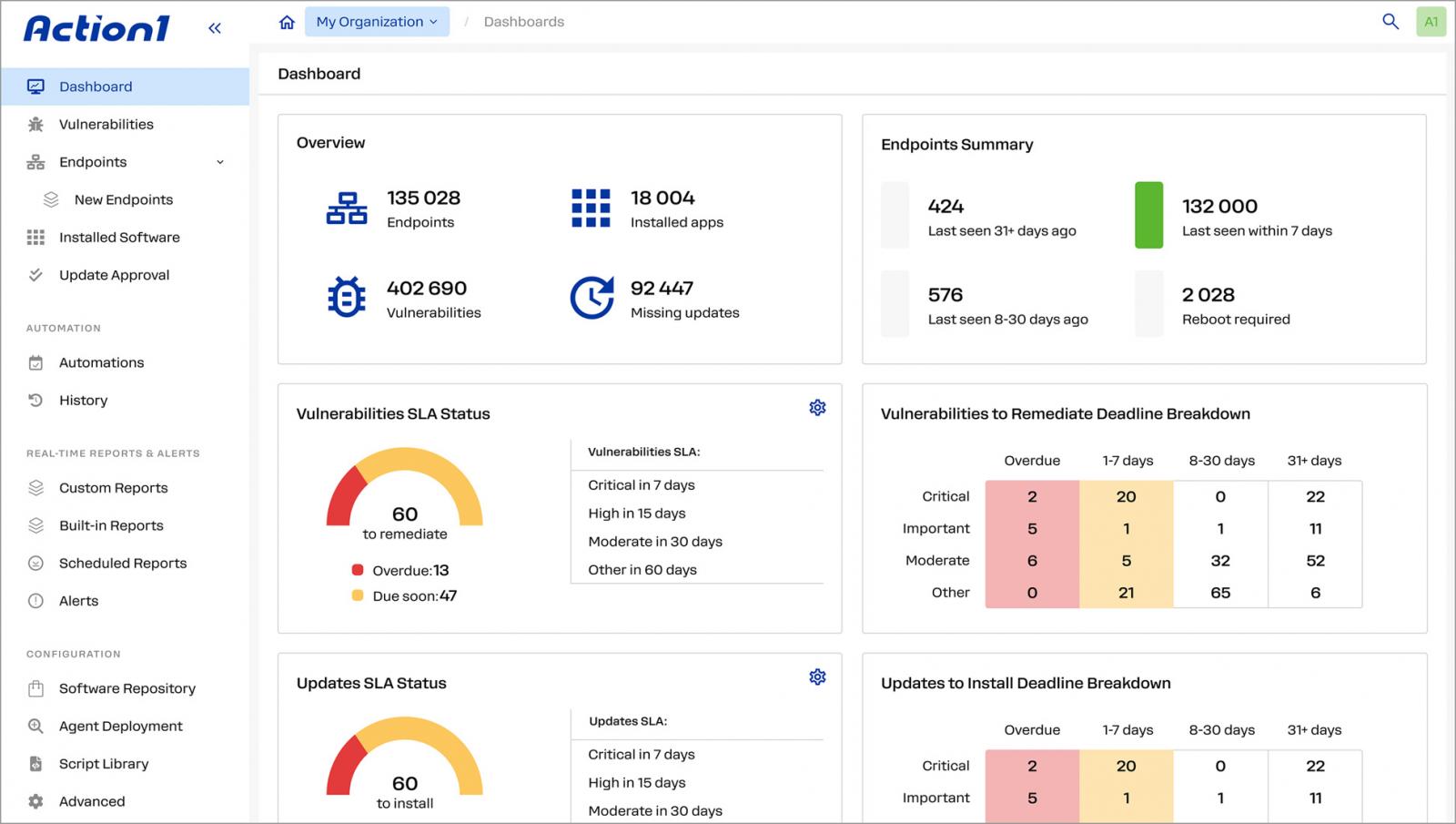
**Action1** integrates vulnerability assessment and remediation into a single workflow, allowing organizations to move from discovery to exposure reduction much faster, all from a unified console. The AI vulnerability era will be defined not by the speed of flaw discovery, but by the agility to understand, prioritize, and patch them. As discovery accelerates, so too must remediation.
**See how Action1 connects real-time OS and third-party vulnerability intelligence with automated remediation to help your team reduce exposure faster.**
**[Start free](https://www.action1.com/free-edition/?utm_source=paidmedia&refid=Art1_Q326_BleepingComputer) and scale when you're ready.**
*Sponsored and written by Action1.*