Pack2TheRoot: Decade-Old Flaw Grants Root Access on Linux Systems
A critical vulnerability, dubbed 'Pack2TheRoot' (CVE-2026-41651), has been discovered in the PackageKit daemon, potentially allowing local Linux users to gain root privileges. This flaw, present for nearly 12 years, enables unauthorized installation or removal of system packages. Patches are now available, urging immediate updates.


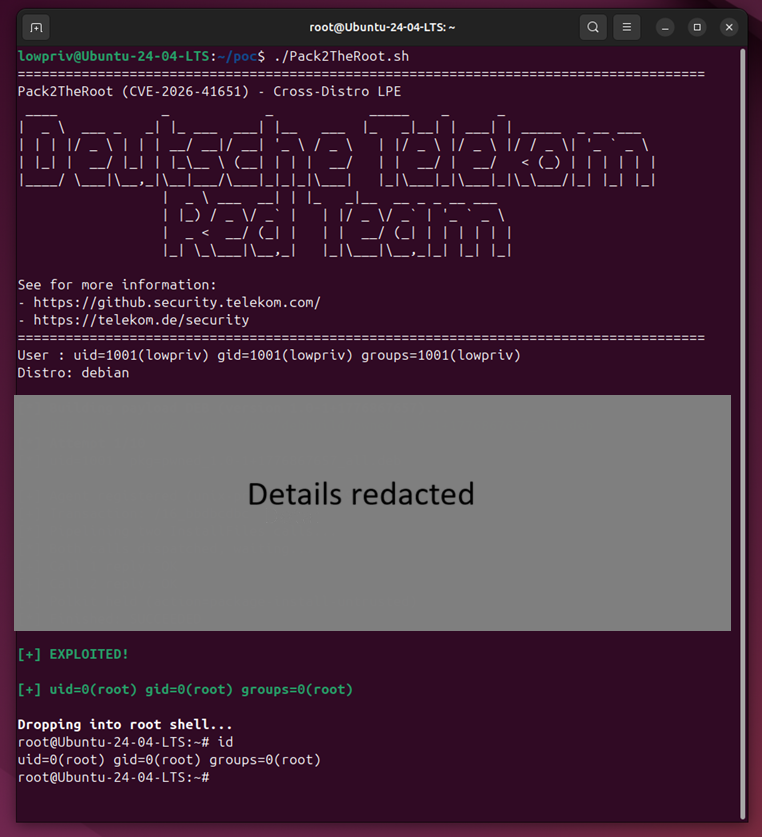
A new vulnerability dubbed **Pack2TheRoot** could be exploited in the **PackageKit** daemon to allow local Linux users to install or remove system packages and gain root permissions.
The flaw is identified as **CVE-2026-41651** and received a high-severity rating of 8.8 out of 10. It has persisted for almost 12 years in the **PackageKit** daemon, a background service that manages software installation, updates, and removal across Linux systems.
Earlier this week, some information about the vulnerability has been published, along with **PackageKit** version 1.3.5 that addresses the issue. However, technical details and a demo exploit have not been disclosed to allow the patches to propagate.
An investigation from the **Deutsche Telekom Red Team** uncovered that the cause of the bug is the mechanism **PackageKit** uses to handle package management requests.
Specifically, the researchers found that commands like `pkcon install` could execute without requiring authentication under certain conditions on a Fedora system, allowing them to install a system package.
Using the **Claude Opus** AI tool, they further explored the potential for exploiting this behavior and discovered **CVE-2026-41651**.
### Impact and fixes
**Deutsche Telekom's Red Team** reported their findings to **Red Hat** and **PackageKit** maintainers on April 8. They state that it’s safe to assume that all distributions that come with **PackageKit** pre-installed and enabled out-of-the-box are vulnerable to **CVE-2026-41651**.
The vulnerability has been present in **PackageKit** version 1.0.2, released in November 2014, and affects all versions through 1.3.4, according to the project's security advisory.
Researchers' testing have confirmed that an attacker could exploit the the **CVE-2026-41651** vulnerability in the following Linux distributions:
* Ubuntu Desktop 18.04 (EOL), 24.04.4 (LTS), 26.04 (LTS beta)
* Ubuntu Server 22.04 – 24.04 (LTS)
* Debian Desktop Trixie 13.4
* RockyLinux Desktop 10.1
* Fedora 43 Desktop
* Fedora 43 Server
The list is not exhaustive, though, and any Linux distribution using **PackageKit** should be treated as potentially vulnerable to attacks.
Users should upgrade to **PackageKit** version 1.3.5 as soon as possible, and ensure that any other software using the package as a dependency has been moved to a safe release.
Users can use the commands below to check if they have a vulnerable version of the **PackageKit** installed and if the daemon is running:
`dpkg -l | grep -i packagekit`
`rpm -qa | grep -i packagekit`
Users can run `systemctl status packagekit` or `pkmon` to check if the **PackageKit** daemon is available and running, which indicates that the system may be at risk if left unpatched.
Although no details about the state of exploitation have been shared, the researchers noted that there are strong signs showing compromise because exploitation leads to the **PackageKit** daemon hitting an assertion failure and crashing.
Even if systemd recovers the daemon, the crash is observable in the system logs.