The Post-Mythos Era: Why Patching Can't Keep Pace with AI-Accelerated Exploits
The cybersecurity landscape has fundamentally shifted. AI-driven automation has dramatically compressed the window between vulnerability disclosure and weaponization, making traditional patch-centric vulnerability management obsolete. As exploit development outpaces remediation efforts, security professionals must rethink their defense strategies.

For decades, vulnerability management operated with the luxury of time: a buffer of months between a vulnerability's discovery and its weaponization. This allowed for a structured process of triage, scheduling, and validation.
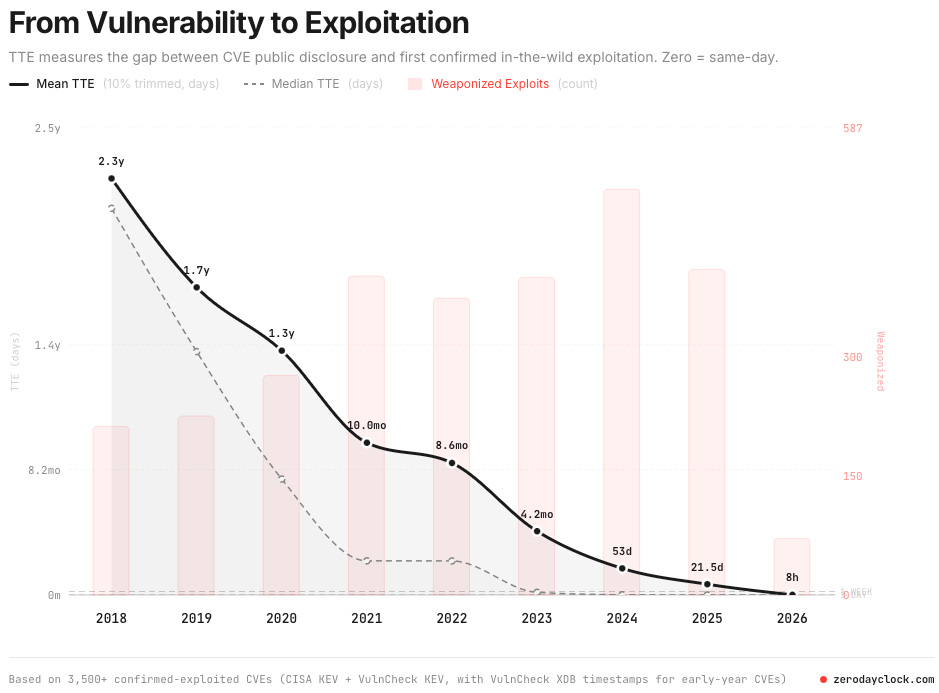
Today, that buffer has all but vanished. Artificial intelligence has eliminated the manual drag on weaponization, reducing the disclosure-to-exploit timeframe from months to mere hours. The **Zero Day Clock** currently averages an astonishing **8 hours for 2026**, a stark contrast to roughly **53 days just two years prior**.
## You Can't Patch Your Way Out of This
The immediate reflex is to patch faster, but remediation isn't a simple toggle. Patches are subject to regression testing, change windows, and uptime commitments. Unfortunately, critical metrics are moving in the wrong direction.
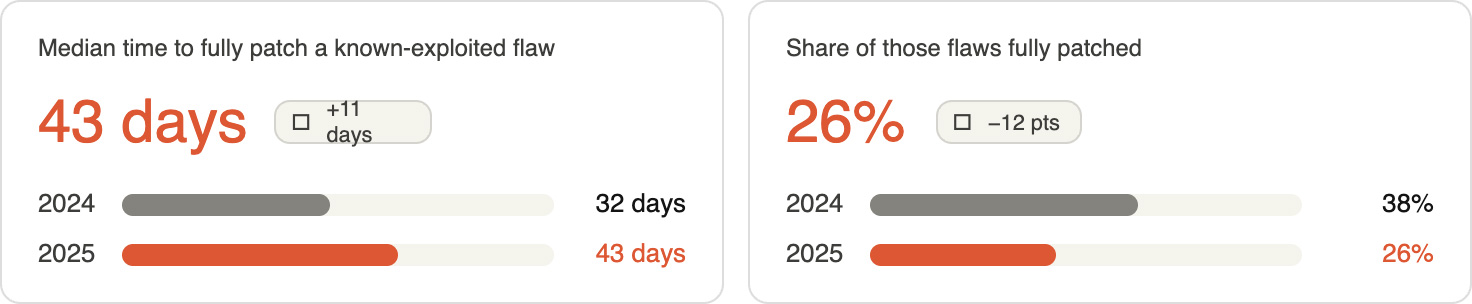
**Verizon's 2026 Data Breach Investigations Report**, analyzing over 13,000 organizations, reveals troubling trends:
* The median fix time for known-exploited vulnerabilities is now **43 days**, up from 32 last year.
* The share of organizations fully patching them has dropped from **38% to 26%**.
* Even top performers close only **30-40%** of these vulnerabilities in the first week, a rate that has stagnated for years.
When offense operates in hours and remediation in weeks, the breach becomes inevitable. The sheer volume of vulnerabilities exacerbates the problem, with **48,185 CVEs in 2025** and fewer than **0.6% ever patched**. The 'patch your way out' strategy is no longer mathematically viable.
Even more concerning, these figures predate the **Mythos** threshold. **Mythos** represents the point where AI models can autonomously discover and weaponize vulnerabilities. **Anthropic's Mythos-class model**, for instance, uncovered a 27-year-old flaw in **OpenBSD**, one of the most secure operating systems. The 2025 baseline is now the floor, not the ceiling.
The question is no longer merely "what's vulnerable?" but "what's actually exploitable against us, right now, with our existing controls?" Proving the correct course of action—patch, mitigate, monitor, or accept—is the critical gap.
## Your Pentest Got Faster. It Still Can't Reach What Matters.
Automated penetration testing has emerged as a popular response, allowing continuous, scaled execution of real exploit chains against assets. While tools like **Picus's Autonomous Penetration Testing** offer strong proof of exploit success, automation doesn't change the reach of live exploitation.
Live exploitation is limited to scenarios where firing an exploit is safe and a working exploit exists. This leaves **three critical gaps** no pentest tool can close:
1. **No exploit, nothing to fire:** A significant portion of disclosed **CVEs** never receive a public or safe exploit. Without a launchable exploit, their exploitability in your environment remains unknown.
2. **Assets you can't risk:** Business-critical, regulated, and air-gapped systems are precisely those you cannot safely detonate an exploit against, yet they are often the most valuable targets.
3. **The day-one window:** Weaponizing a fresh exploit and integrating it into tooling takes time. Attackers are already moving while your launch preparations are still underway.
In a typical enterprise, the slice of your total exposure that can be safely exploited live is usually only **10-15%**. For the remaining **85-90%**, live execution offers no answers.
## Ground-Test the Rocket You Can't Launch
Just as space programs ground-test rockets that are too valuable to risk or still under construction, security teams need alternative validation methods. The **CVE** with no exploit is the rocket on paper; the off-limits asset is the crewed rocket; and the day-one **CVE** is the partly built fuselage.
Live launch is the ideal proof when possible, but ground-testing is the indispensable proof when it's not.
## Break the Chain, Break the Exploit
An exploit isn't a magical event; it's a chain of specific techniques, or **TTPs** (**Tactics, Techniques, and Procedures**), that an attacker must execute sequentially: gain execution, bypass protection, escalate privilege, dump credentials, and move towards the target.
Each link in this chain depends on conditions within your environment and can be tested independently against your deployed controls, much like an engineer tests a rocket engine on a static stand. This is **TTP-chain validation**.
By mapping a **CVE** to its required **TTP** chain and validating each technique against your existing controls, you can determine if your environment would break any necessary link. If a link breaks, the exploit cannot succeed. If every link holds, the exposure is genuinely exploitable, complete with evidence.
This verdict offers four distinct advantages over static **CVSS** or **EPSS** labels:
* **Validation by inference, not detonation:** It works where live exploitation is unsafe or impossible.
* **Control-aware:** The verdict reflects your real **EDR**, **GPO**, **LSASS** protection, allow-listing, and firewall configurations, not just theoretical data sheet numbers.
* **Weighs reachability:** Contained exposures are not over-counted.
* **Ships evidence:** Provides a clear audit trail of the chain, controls tested, and results for reporting.
## What It Looks Like on a Real CVE
Consider **CVE-2025-29824**, a Windows CLFS use-after-free vulnerability that escalates to SYSTEM privileges (observed in the wild with **Storm-2460** leading to **RansomEXX** activity).
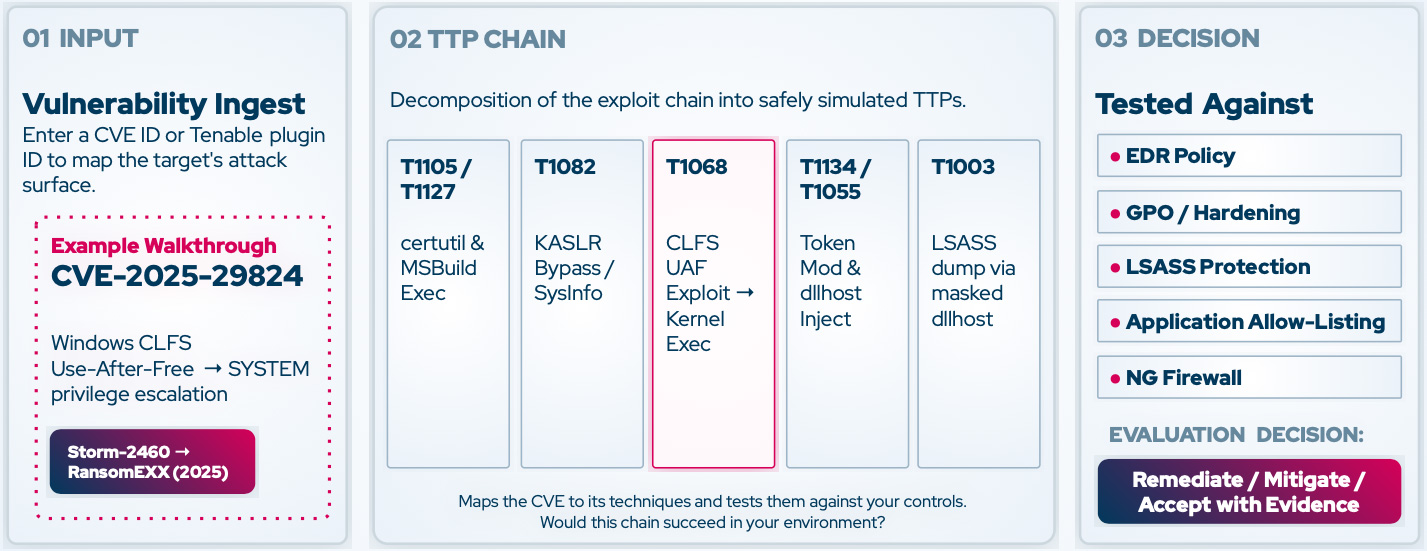
Instead of firing a live exploit, you decompose it into the attacker's required chain and test each step against your security stack:
* `certutil` & `powershell` were used to download a malicious payload.
* The payload required **DLL sideloading** for persistence.
* It then attempted **privilege escalation** via the CLFS vulnerability.
* Finally, it tried to **dump credentials** from **LSASS**.