Prinz Eugen Ransomware: A Deep Dive into a New Go-Based Threat Prioritizing Recent Files
A novel ransomware operation dubbed **Prinz Eugen** is making waves in the cybersecurity landscape, distinguished by its unique encryption strategy that targets recently modified files and its deliberate absence of a traditional ransom note. This Go-based threat, identified by **Threatdown** (Malwarebytes' enterprise arm), operates with a 'hands-on-keyboard' approach, leveraging legitimate RMM tools and living-off-the-land techniques.


The **Prinz Eugen** ransomware operation is emerging as a significant concern for IT security professionals. Unlike many contemporary ransomware groups, **Prinz Eugen** does not appear to operate under a Ransomware-as-a-Service (**RaaS**) model and is not actively recruiting affiliates.
### Access and Persistence
Investigations by **Threatdown** indicate that initial access for **Prinz Eugen** attacks likely occurs through stolen RDP credentials. Once inside, the threat actors manually download and execute the primary payload, 'servertool.exe'.
Researchers observed the use of legitimate Remote Monitoring and Management (**RMM**) software, such as **RemotePC**, and the creation of backdoor administrator accounts to establish persistence within compromised networks. This 'hands-on-keyboard' approach, combined with the use of living-off-the-land tools, makes detection and mitigation challenging.
### Unique Encryption Strategy
A core differentiator for **Prinz Eugen** is its sophisticated encryption strategy. Analysis of the Go-based malware reveals a prioritization of recently modified files for encryption. When files share the same timestamp, they are processed alphabetically.
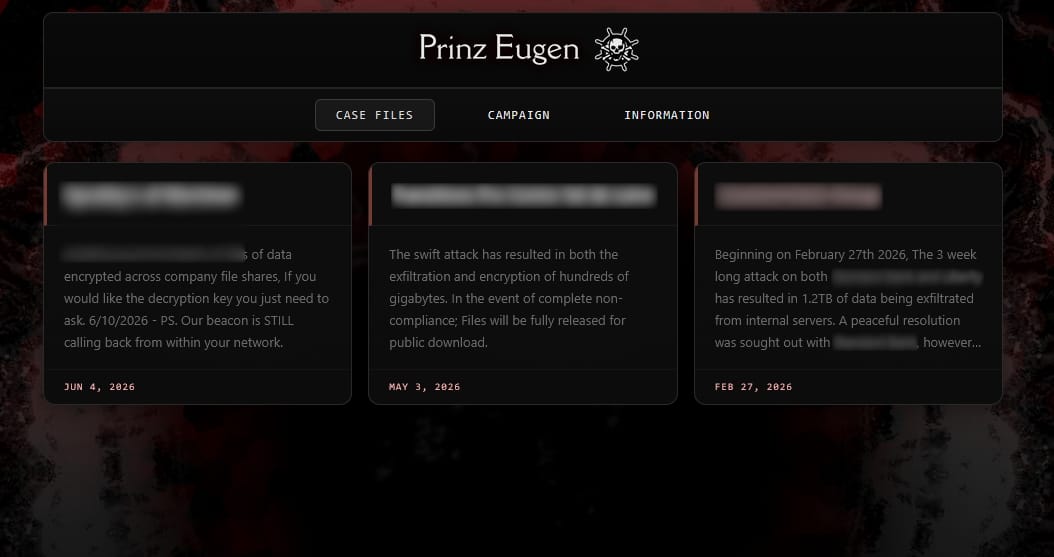
**Currently listed victims on the Prinz Eugen site**
**Threatdown** researchers suggest this method is designed to maximize impact by targeting files most likely to be business-critical and in active use, thereby increasing pressure on victims to pay the ransom. The ransomware recursively checks directories without depth limits or exclusions, encrypting virtually all files except those already marked with its `.prinzeugen` extension.
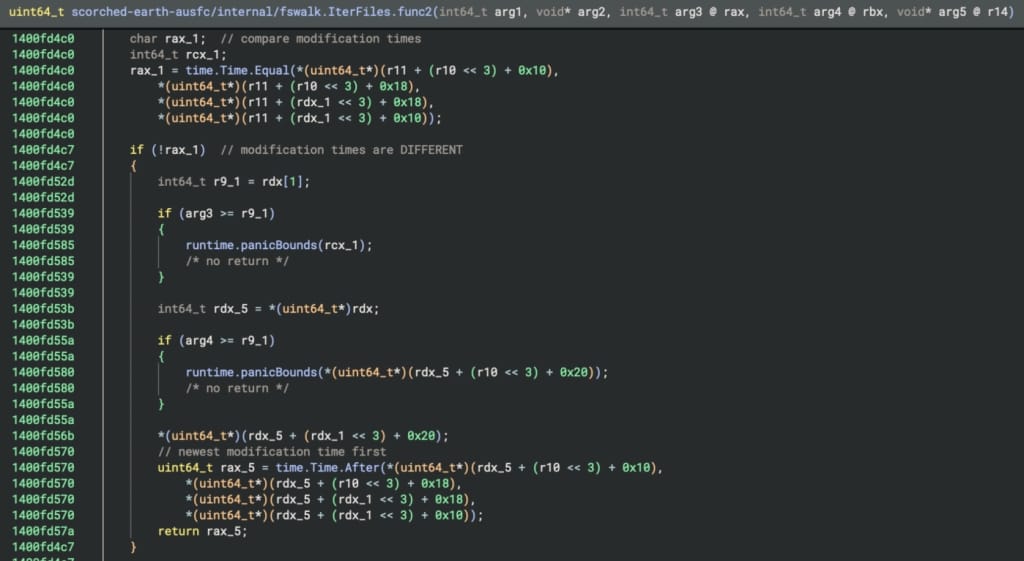
**File scanning function**
The encryption itself employs **ChaCha20-Poly1305** with a 32-byte master key, a random initialization vector for each file, and a key derivation function based on **Argon2id**, **SHA-256**, and **HKDF-SHA256**. The process occurs in 1MB chunks, with **SHA-256** hash functions ensuring file integrity.
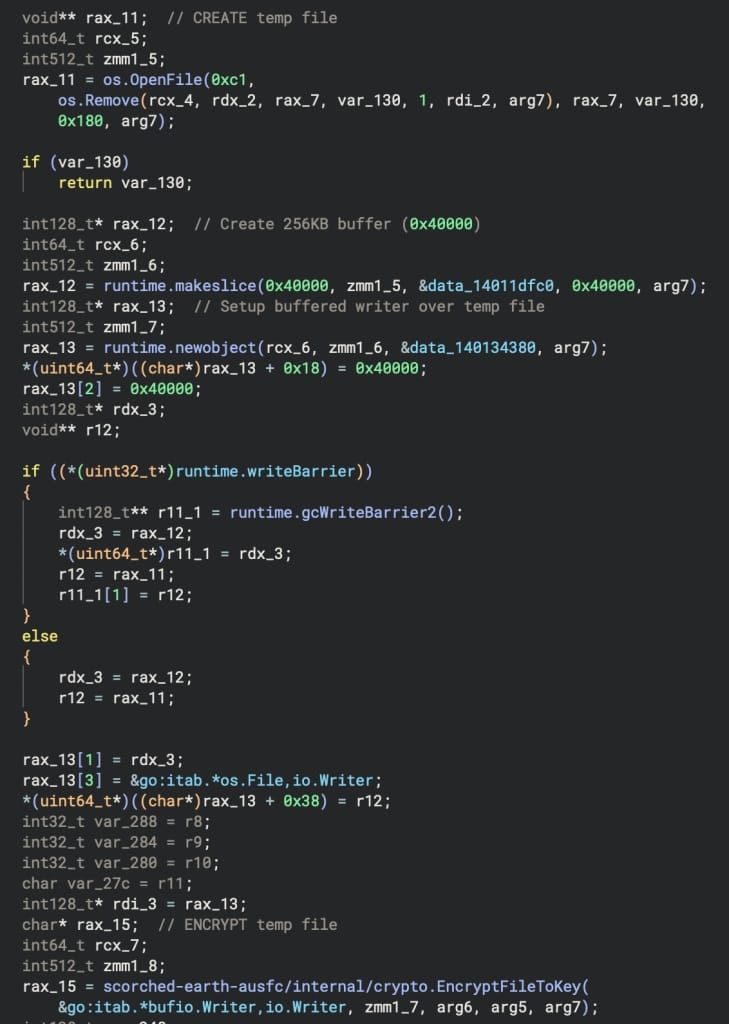
**File encryption routine**
Notably, the malware includes a check to ensure files can be decrypted before deleting the original, demonstrating a level of operational sophistication. To prevent key retrieval, **Prinz Eugen** overwrites encryption keys with zeroes, forces garbage collection, and then self-deletes from disk.
### The Absence of a Ransom Note
One of the most striking characteristics of **Prinz Eugen** is its deliberate omission of a traditional text ransom note or desktop wallpaper change. **Threatdown** researchers highlight this as a growing tactic among organized ransomware groups.
This approach reduces the forensic footprint and complicates the automatic detection of the extortion phase. By moving ransom communications entirely out-of-band—through direct email, phone contact, or dark-web victim portals—the threat actors minimize forensic artifacts, making it harder for security teams to identify the full scope of the attack.
**Threatdown** has identified at least five victims, noting that in the case of the **Standard Bank** breach, a demand for 1 **Bitcoin** was refused. The **Threatdown** report provides a comprehensive list of Indicators of Compromise (**IoCs**) to aid organizations and researchers in detecting and defending against **Prinz Eugen** attacks.