Pro-Ukrainian Hackers Claim Massive Breach of Russia's Federal Statistics Agency, Rosstat
An alliance of Belarusian and pro-Ukrainian hacking groups, **Belarusian Cyber Partisans** and **Silent Crow**, has claimed a significant cyberattack against **Rosstat**, Russia's federal statistics agency. The groups assert they spent months within Rosstat's network, exfiltrating vast amounts of sensitive government data and subsequently launching a destructive operation that disrupted the agency's systems.
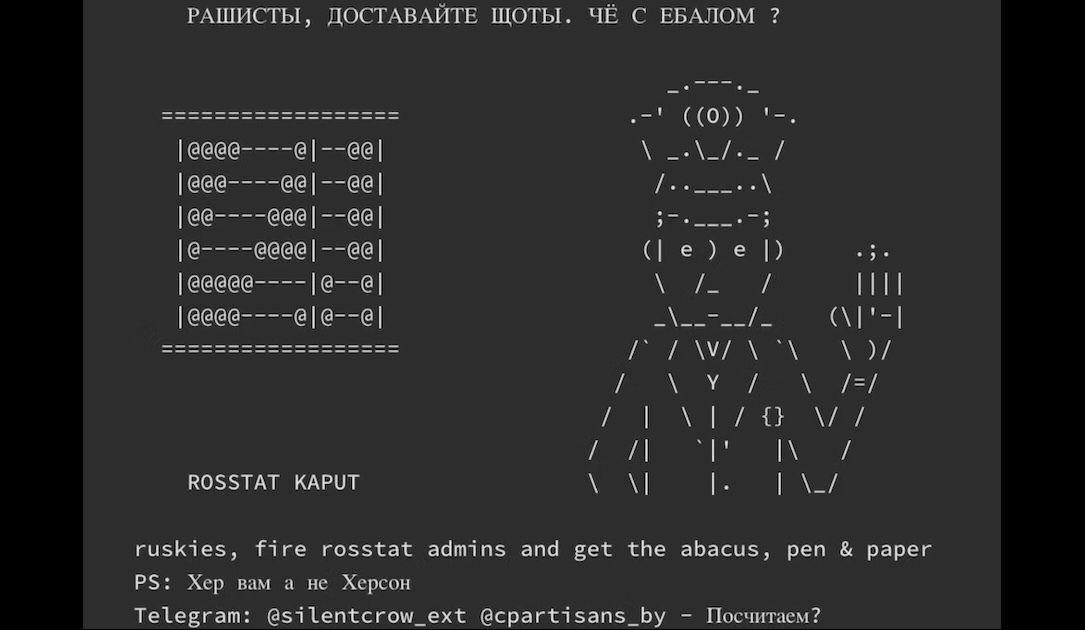
A collaborative effort between the **Belarusian Cyber Partisans** and the pro-Ukrainian hacking group **Silent Crow** has reportedly resulted in a major cyberattack targeting **Rosstat**, Russia's federal statistics agency. The groups announced on Sunday that they had maintained persistent access to Rosstat's network for several months before initiating a destructive operation that allegedly wiped servers and disrupted critical systems.
**Rosstat** has acknowledged a cyberattack but disputes the full extent of the hackers' claims. The agency stated it found no evidence of protected information leakage or compromised databases. In a statement to Russian state news agency TASS, Rosstat indicated that its security systems detected suspicious activity, allowing specialists to respond. The agency is reportedly collaborating with cybersecurity experts and law enforcement to identify the perpetrators.
### Deep Infiltration and Data Exfiltration
Rosstat, responsible for collecting and publishing official statistics on Russia's population, economy, and social conditions, holds extensive government data, including demographic records and information from Russian-occupied Ukrainian territories.
According to the **Cyber Partisans**, initial access to Rosstat's network was gained approximately six months ago. The subsequent four months were spent on covert reconnaissance, lateral movement, and data collection within the systems. "We reached the agency's critical systems while systematically extracting sensitive data and internal documents," the group claimed.
The destructive phase of the operation was reportedly prepared over a month, with intensified activity in the two weeks leading up to the attack. The culmination, occurring overnight on Saturday, involved the alleged destruction of physical and virtual servers, alongside large-scale data storage systems.
**Silent Crow** claimed the operation provided access to approximately 25,000 computers and devices across Rosstat's headquarters, regional offices, and main statistical data processing center. The group purported to have compromised systems managing the agency's network, including domain controllers, virtualization platforms, and infrastructure management tools. They also claimed to have breached databases containing economic, demographic, personal information, census records, and internal government correspondence.
Allegedly stolen material includes confidential mortality records detailing causes of death in Russia, nonpublic statistics from Russian-occupied Ukrainian territories, and information regarding Russian military casualties in the conflict with Ukraine. The hackers plan to release a detailed account of the operation and samples of the exfiltrated data in the coming days.
### Defacement and Prior Operations
The groups also claimed to have replaced content on Rosstat's servers with official Ukrainian statistics on Russian military losses. This information was reportedly publicly accessible for about an hour before system disruptions began. Russian newspaper Kommersant reported that hackers defaced Rosstat's main website and regional portals, displaying messages including a Belarusian warning: "No one will escape accountability."
### A Familiar Alliance
This is not the first instance of these two hacking groups collaborating against significant Russian organizations. In July 2025, the **Cyber Partisans** and **Silent Crow** claimed responsibility for a disruptive cyberattack on **Aeroflot**, Russia's flagship airline, which led to numerous flight cancellations and affected thousands of passengers. That operation allegedly involved the destruction of IT infrastructure and the theft of sensitive information, including flight records and internal communications.
The **Cyber Partisans** noted that Rosstat presented a more formidable target than Aeroflot, stating, "Unlike Aeroflot, which we attacked in 2025, Rosstat had a more robust security system."
The **Belarusian Cyber Partisans** emerged following protests against President Alexander Lukashenko in 2020 and have since conducted cyber operations against Belarusian and Russian government institutions. In October, the group disclosed an infiltration of Moscow's healthcare network in 2023, claiming administrator-level access to systems connected to other government agencies.
**Silent Crow** has also claimed responsibility for attacks on Russian government agencies and businesses, including an earlier breach of **Rosreestr**, the country's state property registry.
In July, Russia's Supreme Court designated both hacking groups as extremist organizations, effectively outlawing their activities and exposing associated individuals to potential criminal prosecution. However, the practical impact of this designation remains unclear, as the groups continue to target Russian organizations.
"It looks like Rosstat will have to recalculate not only its statistics this time, but also the scale of its own problems," **Silent Crow** commented.