Reclaiming Digital Privacy: The Power of Compartmentalization and Personas
In an internet economy built on surveillance capitalism, personal data has become the product, and users are the raw material. This article explores how active compartmentalization and the use of digital personas can empower individuals to regain control over their online privacy and mitigate the pervasive risks of data aggregation and breaches.
Over the past two decades, the internet has quietly restructured itself around a business model that thrives on knowing every detail about you. Every app, account, website, and form contributes to a vast data ecosystem designed to track, profile, and monetize your identity.
This phenomenon, often termed **surveillance capitalism**, creates an economy where attention and personal data are the product, and individuals serve as the raw material. The mechanics are subtle yet pervasive: a single email address can link your shopping habits, health searches, location history, and social connections.
**Data brokers** exist specifically to aggregate these threads, buying, selling, and cross-referencing fragments of your life to construct profiles more comprehensive than most people realize about themselves. This isn't a consequence of a breach or a hack; it's the default operational mode of much of the internet. These brokers often handle personal information without consumers' awareness or informed consent.
The result is that privacy is no longer a default expectation but an active construction, built piece by piece against the current of nearly every service used. While the harms are diffused and delayed, they manifest as spam, price discrimination, identity theft, and a general erosion of control over one's digital identity.
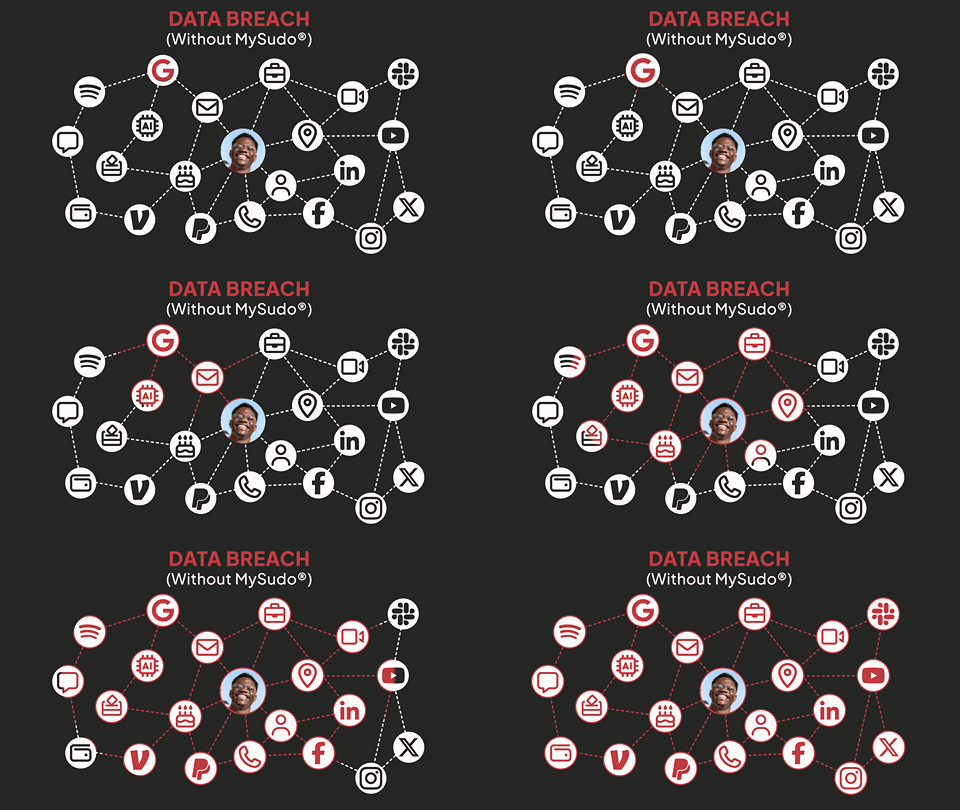
Artificial Intelligence (AI) systems have significantly exacerbated this problem. **Data brokers** now leverage AI to link disparate actions in ways previously deemed impossible. AI's prowess in data analysis allows it to sift through vast amounts of information, correlating actions into highly valuable profiles.
In this landscape of **surveillance capitalism**, the critical question arises: can the privacy pendulum be shifted back in the user's favor? Is it genuinely possible to maintain privacy, security, and safety online?
## Personas and Compartmentalization
If **surveillance capitalism** thrives by linking every aspect of your digital life into one exploitable profile, the countermeasure is structural: breaking these correlating identifiers. This is the core premise behind compartmentalization. Instead of using a single set of identifiers—one email, one phone number, one payment method, one communication handle—across all contexts, individuals deliberately segment their activities into separate, purpose-built personas.
Imagine one persona for online shopping, another for dating apps, a third for travel, a fourth for marketplace listings, and even another for a newsletter you're unsure about. Each persona operates as a self-contained identity, equipped with its own email address, phone number, payment method, browser, and communication handle. Crucially, these personas are not connected to each other or back to your actual identity in any way that a **data broker** or advertiser could observe.
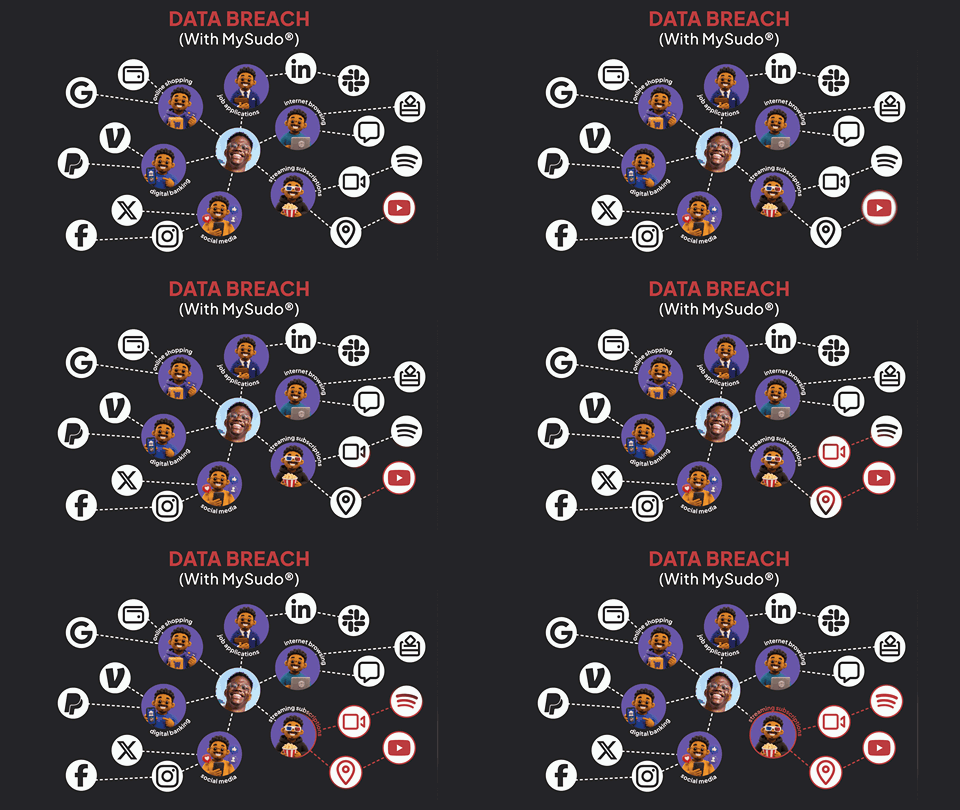
Should a persona be compromised in a breach, attract spam, or be sold to a marketing list, the damage is contained and cannot be tied back to your core identity. This represents a fundamental shift from traditional security models that focus on protecting a single identity with stronger passwords or encryption. Compartmentalization assumes that any single identity will eventually become correlated and prepares for this by ensuring that no single identity holds all the value due to its changeability.
This approach isn't about building an impenetrable fortress but rather about not placing all your valuable assets behind one wall. Its elegance lies in not requiring the entire internet to change; instead, it introduces an intermediary layer that generates and manages these personas on your behalf.
**Anonyome Labs** has patented many of the foundational concepts related to online personas and compartmentalization, including:
* **Persona based Telephony:** US9374689Β1 Apparatus and Method for Support Telephonic Synthetic Identities
* **Persona based Email:** US9729519Β1 Email Application for Synthetic Identities
* **Safe Persona Usage:** US10178106Β1 Apparatus and Method For Identifying and Warning of Synthetic Identity Behavior That Reduces User Privacy
* **Persona based VPN:** US10320753Β1 Method and System For Providing Persona Masking in a Computer Network
* **A Persona Management System:** US10356052Β1 Apparatus and Method for Administering Proxy Identities
## How MySudo Puts This Into Practice
While compartmentalization and personas represent a significant advancement, the challenge lies in making them usable and automatic for typical users without requiring specialized technical knowledge. This usability has been a primary focus for **Anonyome Labs**.
**MySudo** was designed to implement this paradigm, allowing each user to create up to nine distinct personas, or *Sudos*. Each Sudo provides a different set of digital tools:
* A unique phone number for calls and SMS.
* A dedicated email inbox for sending and receiving emails.
* A virtual payment card for secure online purchases.
* A communication handle for end-to-end encrypted (E2EE) messaging, voice, and video calls (similar to **WhatsApp**).
* A separate browser for complete isolation of browsing activities.

**MySudo** is available in two form factors:
* **A mobile app for iOS and Android:** This enables each persona to communicate externally via phone calls, SMS, and emails. It also allows for the creation of individual payment cards, E2EE messaging, voice, and video, and provides a separate browser for each persona.
* **A desktop companion app for Windows and Mac:** This facilitates the management of persona emails, offering a more suitable interface for longer and more complex communications. Additional features are slated for future release on the desktop app.
**MySudo** is part of a growing suite of privacy and security applications from **Anonyome Labs**, which also includes a privacy-focused **VPN** and an upcoming **Password Manager**.
Individual online privacy has been under constant pressure since the dawn of the web. Now, users have identity-based tools to push back. By creating multiple personas and compartmentalizing their digital lives, individuals can actively reap significant privacy benefits. Your identity is already being pieced together; it's time to stop handing over the pieces.
[Download MySudo now](https://anonyome.com/mysudo-bc/) to create separate digital identities that keep your personal information private and out of reach from **data brokers**, scammers, and the next data breach.
*Sponsored and written by **ANONYOME LABS**.*