UK Establishes New National Centre to Combat Hostile State Disinformation
The United Kingdom is taking a decisive stand against the rising tide of foreign disinformation with the announcement of a new National Centre for Information Defence. Prime Minister **Andy Burnham** revealed plans for the center, designed to detect, attribute, and disrupt hostile state-sponsored influence operations, particularly as European elections loom.
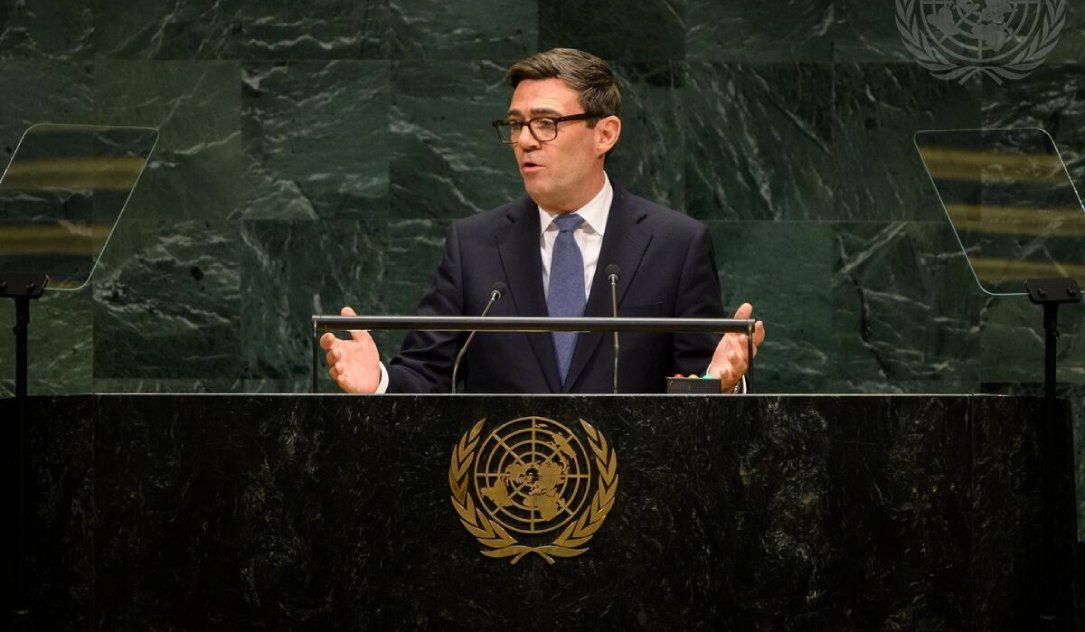
British Prime Minister **Andy Burnham** announced Tuesday that he has ordered security chiefs to commence work on a new national center aimed at combating hostile state disinformation. Speaking at the U.N. General Assembly in his inaugural address as prime minister, Burnham emphasized the **United Kingdom's** readiness to share its expertise with other nations.
"As more elections approach across Europe, more nations are grappling with these issues – some for the first time," Burnham stated. "So we’re ready to share our understanding of how these actors work, and how we can respond — because this is vital for our collective security and resilience."
While details remain sparse regarding the ultimate structure of what Burnham termed the **National Centre for Information Defence**, initial efforts are understood to be led by the **Cabinet Office**. This initiative will involve intelligence agencies, other government departments, law enforcement, and social media companies in shaping the center's operational framework.
This announcement arrives amidst growing concerns among European governments, who increasingly characterize Russian cyberattacks, sabotage, and influence operations as elements of a broader hybrid warfare campaign.
Earlier this year, the **UK** and the **European Union** imposed sanctions on Russian cyber and disinformation actors, including a media outlet accused of election interference in Moldova and Armenia.
### The AI Factor in Influence Operations
Experts are concerned that artificial intelligence (AI) is significantly reducing the cost and complexity of running such operations. Recent reports from The New York Times highlight that state-linked actors in **Iran** and **China**, alongside a private Israeli firm, have begun deploying largely autonomous AI systems to conduct influence campaigns with minimal human intervention.
**Sophie Williams-Dunning**, a research analyst at the **Royal United Services Institute** think tank, told Recorded Future News that Britain "has been overdue a more coherent strategic response to this threat." She noted that the threat landscape has evolved considerably, while the government's response has been fragmented across various departments.
Williams-Dunning cautioned, however, about the distinction between a center within the Cabinet Office and an agency accountable to Parliament. "I’d hope this is meant to be the foundation for the latter, not one more unit similar in resourcing to the ones already out there," she added.
**Joe Devanny**, a senior lecturer at **King’s College London**, echoed this sentiment, suggesting that a new center "can mean a lot of different things," from merely rebadging existing efforts to a significant strategic overhaul. The specifics of the new body's scope and powers are yet to be clarified, with a spokesperson for the prime minister's office indicating that more information would be released in due course.
### The Moscow Playbook and UK's New Stance
Prime Minister Burnham directly accused Russian agencies of employing bots and fake websites, falsifying newspaper articles, mimicking the branding of 28 British organizations—including universities and the **BBC**—and amplifying far-right narratives.
The government's efforts will also focus on strengthening the country's ability to foster community resilience in identifying and combating disinformation, particularly in the wake of reports linking riots in Belfast and Southampton to foreign agitation.
"The Kremlin spends around £1.3 billion ($1.7 billion) each year on manipulating information," Burnham stated. "We’re talking about an insidious campaign that reaches into people’s homes and twists what they feel about their own country and community – creating a narrative of decline, stoking division and sowing despair."
Burnham asserted that Britain has "given too much ground" over the past decade to those promoting a "negative, corrosive narrative" about the country. "Well, no more," he declared. "We are going to face the new decade in a different way — with our eyes wide open. We are going to be much prouder in standing up for our values and the rule of law."
### Challenges and International Models
The **National Security Act 2023** introduced a criminal offense specifically targeting foreign interference. However, Williams-Dunning noted that this offense has proven challenging to implement due to a high evidentiary threshold, especially in proving foreign orchestration. "One of the first tasks for this centre will be finding a way to actually implement it," she said.
**France** and **Sweden** already operate agencies dedicated to countering foreign disinformation and influence operations. France's **Viginum**, established in 2021, serves as a potential model for a specialized body focused on foreign information operations.
**Anne-Sophie Dhiver**, Viginum's deputy head, previously told Recorded Future News that their agency exclusively targets foreign operations involving fake accounts, bots, or other coordinated inauthentic behavior. She clarified that Viginum does not investigate domestic actors or assess the veracity of individual claims, aiming to avoid comparisons to George Orwell’s Ministry of Truth—an accusation leveled at some existing British units.
Williams-Dunning pointed out that Viginum's mandate is narrower than what Burnham has described. "Viginum doesn't have an explicit mandate for disruption — its main effort is coordination, detection and public attribution, including debunking and prebunking," she explained.
Burnham’s language, however, "suggests something closer to defending forward," she added. The precise meaning of "disruption" in practice for the new **National Centre for Information Defence**, along with its operational powers, remains to be seen.
London has historically employed sanctions, domain seizures, law enforcement actions, and regulatory powers against foreign influence networks, with these authorities distributed across various government bodies, from the **Foreign Office** to the **Treasury**. British authorities have also previously utilized offensive cyber capabilities against **Islamic State** propaganda networks, powers now consolidated under the **National Cyber Force**.