Unmasking the Early Warning Signs of Software Supply Chain Attacks in the Digital Underground
Software supply chain attacks often become visible only after significant damage has been done. However, new research from Flare suggests that the digital underground frequently provides subtle, yet critical, early indicators of impending threats. Understanding these veiled signals is crucial for IT security professionals looking to preempt sophisticated attacks.


Supply chain attacks, typically discussed post-incident—after a malicious package, compromised update, or vendor breach comes to light—often exhibit less obvious early warning signs. In the clandestine corners of underground forums and marketplaces, the relevance to a supply chain attack isn't always explicitly labeled. Instead, threat actors might advertise access to **GitHub** repositories, private source code, **API** keys, **OAuth** tokens, cloud credentials, or **CI/CD** data.
The true risk emerges from the nature of this access and the trust relationships it implicates.
A recent investigation by **Flare** researchers into underground posts reveals that while challenging to pinpoint, early indicators of software supply chain attacks frequently appear in these illicit spaces, often long before public incident reports emerge.
## What is a Software Supply-Chain Attack?
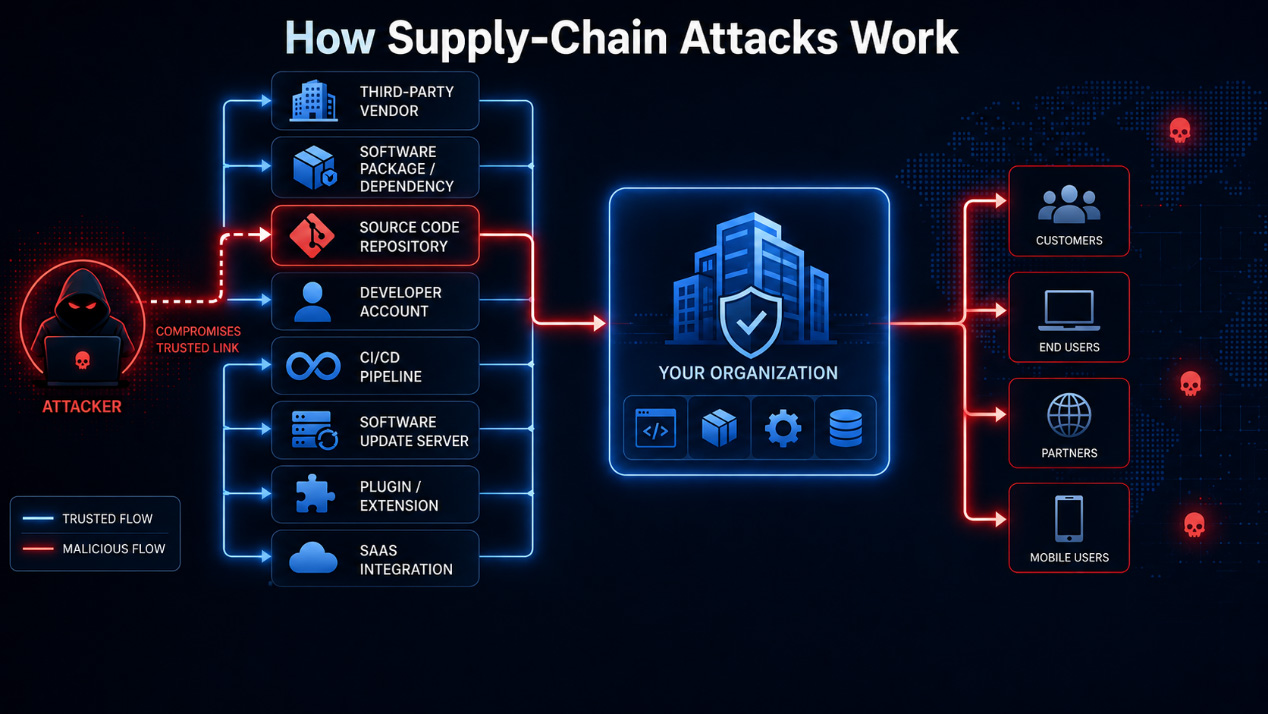
A software supply chain attack targets the trusted tools, vendors, software components, services, or processes an organization relies on, rather than directly attacking the organization itself. This can involve compromising a third-party provider, a developer account, a source-code repository, a package registry, a **CI/CD** pipeline, an update mechanism, a plugin, or a **SaaS** integration.
The inherent danger lies in an attacker's ability to compromise a trusted element within the delivery chain. This allows them to reach downstream customers, users, or internal systems through what appears to be legitimate access, updates, code, or integrations.
## When Ordinary Access Becomes Supply-Chain Relevant
One compelling example observed by **Flare** researchers involved a post advertising **GitHub**-related access, including references to developer accounts, private repositories, access material, and source-code exposure.
While this might initially appear as a standard access sale, **GitHub** access can provide far more than just code. It can expose sensitive secrets, deployment scripts, package publishing logic, cloud credentials, internal documentation, and **CI/CD** workflows.
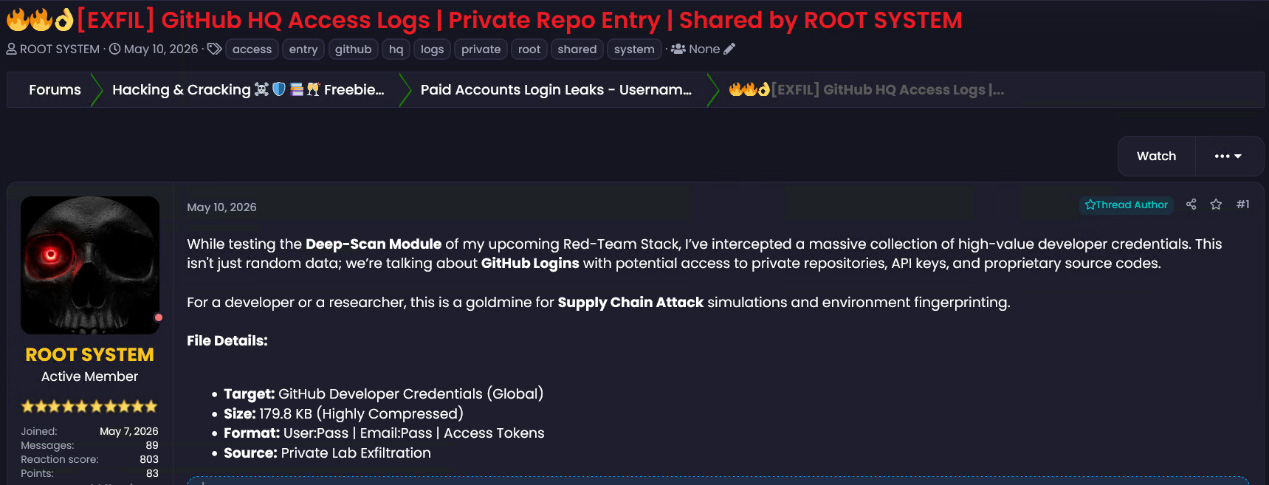
This is where the supply chain angle begins.
If attackers gain control of a developer identity or a private repository, they can gain insights into software build processes, dependency usage, secret storage locations, and update publication methods. In certain scenarios, this level of access can facilitate direct attacks against customers, downstream users, or other interconnected systems.
The **Vercel** incident in April 2026 serves as another pertinent example. It demonstrated how a compromise involving a trusted third-party **AI** tool and **OAuth**-connected **SaaS** access could escalate into a broader security concern, even if sensitive customer data and source code were reportedly untouched.
For analysts reviewing underground posts, the significance isn't the public incident itself, but the type of exposure it represents: trusted integrations, **SaaS** accounts, internal tools, environment variables, and developer platforms connected via permissions that can be exploited if a single link in the chain is compromised.
This underscores why underground posts mentioning **OAuth** access, **SaaS** tools, environment variables, or developer platforms warrant close attention, even if the initial claims appear limited or unverified.
## Source Code: More Than Just Intellectual Property
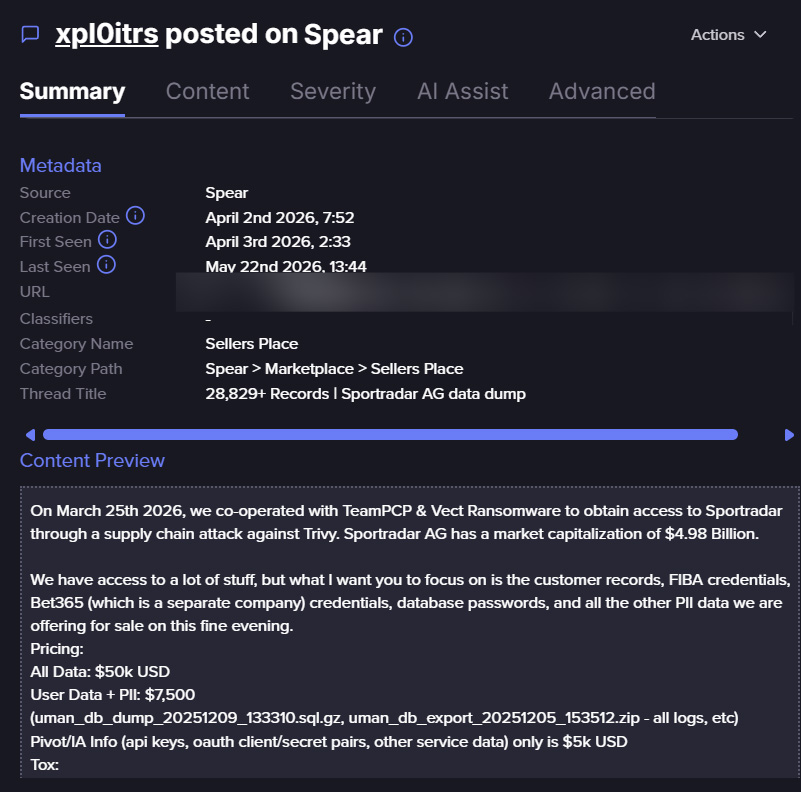
**Flare** researchers also examined posts related to alleged vendor data and source-code exposure, including claims concerning **Sportradar AG**, which later resonated with public reports on the broader **TeamPCP** supply chain campaign.
The **Sportradar** case was linked to a compromised **Trivy** scanner and revealed sensitive operational data, such as database passwords, **API** key and secret pairs, **Kafka** credentials, and monitoring tokens.
This data's significance extends beyond the immediate breach. Such information can reveal how a vendor's systems are interconnected, which services and integrations are trusted, and which credentials could pose risks to partners or customers.
In supply chain investigations, these details are paramount. The most dangerous aspect of a leak is often not the stolen database itself, but the access paths and trusted relationships it exposes.
A similar point emerged from public reporting surrounding **TeamPCP** and **Mistral AI**. In May 2026, reports claimed that **TeamPCP** was selling hundreds of alleged **Mistral AI** repositories. While **Mistral** disputed parts of the claim, the incident still highlights why source-code theft should not be exclusively viewed as an intellectual property concern.
Repositories can contain credentials, build logic, internal service names, deployment workflows, **API** documentation, or references to customers and integrations.
Even if leaked source code doesn't immediately grant production access, it can significantly aid attackers in mapping an environment and identifying future attack vectors.
## Package Attacks: Scaling Access
The same analytical approach applies to package ecosystem incidents. Public reporting on **Shai-Hulud**, a self-spreading **npm** supply chain attack that stole developer secrets and infected trusted packages, illustrated how compromised **npm** maintainer accounts and malicious package updates could be leveraged to steal credentials, harvest **CI/CD** secrets, and propagate across repositories.
The significance here was not merely the malicious code, but the exploitation of trusted package publishing mechanisms.
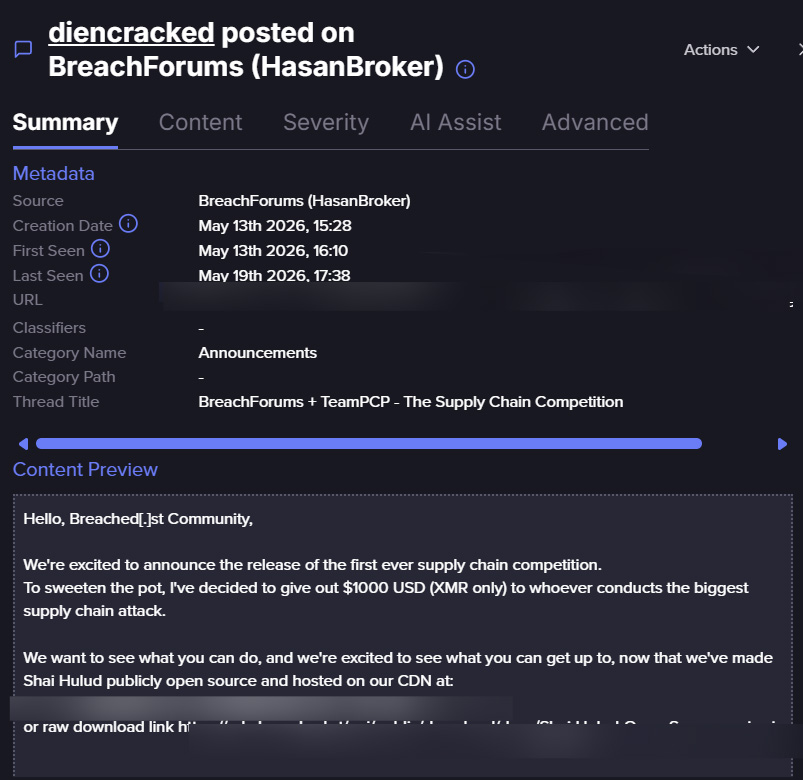
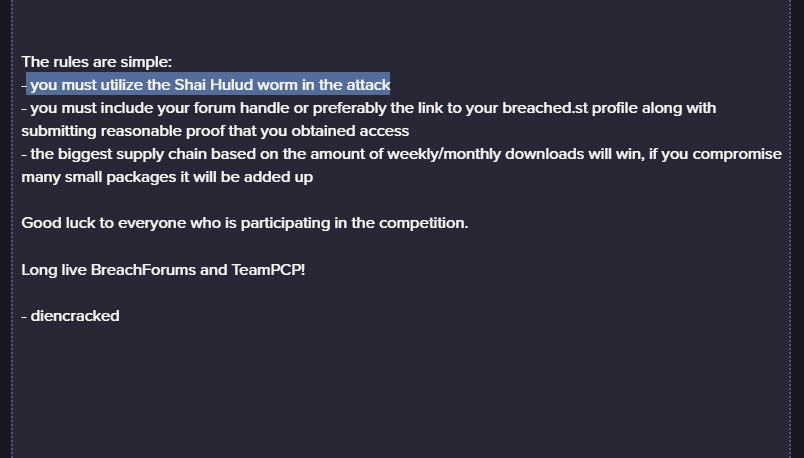
Discussions around **Shai-Hulud**-style activity and competition in supply chain attacks were also observed. While less concrete as victim leads, these posts offer valuable threat intelligence, indicating that actors are monitoring public package compromise techniques and strategizing how to reuse, modify, or extend them.
The **LiteLLM** supply chain incident provides another recent example. Public reports detailed unauthorized **PyPI** package publishes linked to a broader compromise path involving developer and **CI/CD** environments. Given **LiteLLM**'s role as an **AI** gateway, this incident also demonstrates the expanding reach of supply chain risk into **AI** infrastructure and developer tooling.
Developer environments themselves are increasingly attractive targets. Recent reports on malicious **VS Code** extensions showed how trusted development tools can become a conduit to repositories and credentials. Extensions, plugins, and **AI** coding tools often reside in close proximity to source code, terminals, tokens, and internal workflows, making them high-value targets even when not part of production infrastructure.
## What Defenders Can Take From This
The reviewed posts do not conclusively prove that every underground access sale is a supply chain threat. However, they unequivocally demonstrate why security teams must ask more incisive questions when encountering posts involving source code, developer accounts, **SaaS** access, and similar exposures in the digital underground. Proactive monitoring and a deeper understanding of these subtle signals are essential for bolstering defenses against the evolving landscape of software supply chain attacks.